Flyers and brochures help startups explain what they offer, while business cards make introductions to potential clients and partners. For printing for startups on a budget, choose materials that communicate your offer quickly and reach your audience where they are.
Every business expense should serve a purpose. Print can introduce a service, explain a product or start a conversation, rather than simply adding to your marketing materials. This guide compares useful print formats, shows how to create a consistent design across several items and explains how to assess print spending against business goals. It also covers file preparation and where brochures, flyers, business cards and posters can fit into a focused startup plan.
Key Takeaways
- Use flyers and brochures to explain your offer at a glance, with content tailored to the audience and place where you’ll share them.
- Choose print formats around a clear business need, and adapt core design elements across materials to keep your communications consistent.
- Compare print spending with realistic revenue forecasts, using conservative and optimistic projections when you lack past sales data.
- Weigh in-house production against outsourced printing by considering equipment, supplies, operating needs and the quantity you expect to print.
- Plan print-on-demand carefully to limit inventory, while checking how production and fulfilment choices affect your workflow and customer experience.
1. Flyers and brochures for sharing business information
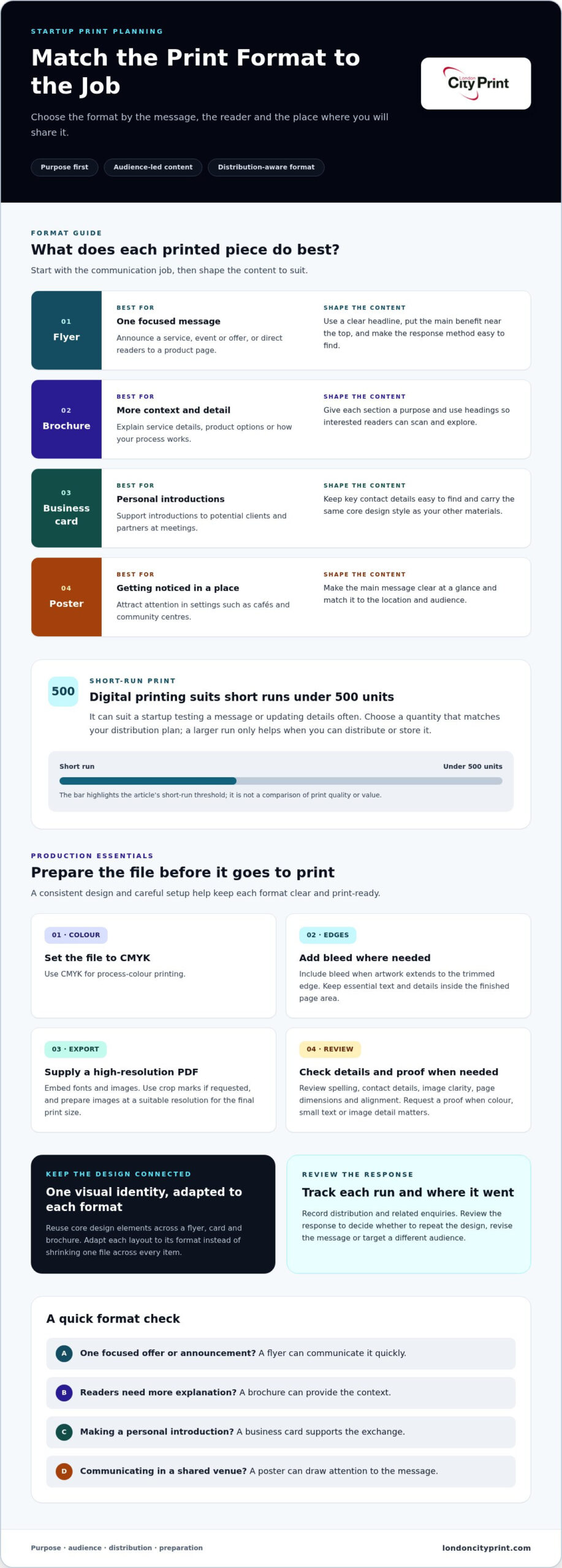
Flyers and brochures give prospective customers a quick introduction to your startup’s offer. Use a flyer for one focused message, such as announcing a service or directing readers to a product page. Choose a brochure when readers need more context, such as service details, product options or an explanation of your process. Match the format to the amount of information and the time readers have.
Start with one audience and one action. A local café customer may need a brief introduction and a clear way to follow up. A prospective business client may need service descriptions and examples before arranging a meeting. Write the headline for that reader, put the main benefit near the top, and make supporting details, contact information and the next step easy to find.
Plan the layout before preparing artwork. Give each section a purpose and use headings to make the content easy to scan. Apply a consistent type style and colour palette across your flyer and brochure. Set up the file in CMYK for process-colour printing and include bleed where artwork extends to the trimmed edge. Keep text and essential details safely inside the finished page area.
Let distribution shape the content and format. Flyers can give people a quick overview of your offer in busy locations. For a community centre or local event, a concise flyer with one offer and a response method may work well. Posters can attract attention in cafés and community centres, while brochures give interested readers more detail to take away. Match each item to its audience and setting.
Review the design as a practical communication tool. Ask someone unfamiliar with your startup to identify what you offer, who it serves and what action to take. If they miss one of those points, simplify the copy or revise the visual hierarchy. Check every phone number, email address, web address and product name before sending the file to print.
A disciplined approach to printing for startups on a budget starts with a clear purpose, not a large print run. Track each run alongside where the materials were distributed and the enquiries they generated. In your regular review, compare the response with your marketing budget. This record helps you decide whether to repeat the design, revise the message or target a different audience next time.
For a printing business with a $50,000 initial investment and a monthly budget balance of $2,000, it would take 25 months to recover its startup costs; use that kind of calculation to test whether a proposed print run fits the business’s cash position. When validating assumptions, increase historical expense or business data levels by around 3% for annual inflation. Market estimates also need scrutiny: treating a $100MM industry as support for a $50MM business would imply 50% market share, so test whether expected demand and distribution can justify it.
The episode includes a chapter about moving a printing business from home at 30:06, a reminder to account for operational changes as the business grows.
2. Economical print materials
As you launch, choose print materials according to purpose, audience and distribution plan. Business cards support introductions at meetings, while flyers communicate one offer or event. A compact brochure suits readers who need more detail before getting in touch. Give each format a clear next step, such as visiting a product page or booking a conversation. Choose a quantity that matches your actual distribution plan, not an optimistic estimate.
Digital printing is most efficient for short runs under 500 units. This suits startups testing a message or updating details frequently. Larger print quantities typically reduce the amount spent on each item, but only help when you can distribute or store the full run. Reuse a core visual design across a flyer, card, and brochure to limit separate design work. Adapt each layout to its format rather than shrinking one file across every item.
How can startups reduce printing costs without sacrificing quality? Keep the design focused, choose a suitable paper stock and order a quantity you can use. Request a proof when colour, small text or image detail matters, then correct any errors before approving production.
What file formats, resolution, bleed and colour settings do print shops require? Supply a high-resolution PDF with fonts and images embedded, set the colour to CMYK, and add bleed when artwork extends to the trimmed edge. Use crop marks if requested, and prepare images at a suitable resolution for the final print size.
Quality depends on preparation as well as material choice. Check spelling, contact details, image clarity, page dimensions and alignment before exporting. Preflight checks can catch common setup problems, such as missing bleed or fonts. Keep an approved master file so later print runs use the same layout and information.
What are the risks of choosing a printing service based only on a low headline price, and how can startups avoid them? The finished work may not meet your needs if the colour, trimming, paper stock or delivery differs from your requirements. Compare specifications, proofing and production details, not just promotional claims. Record the finished size, paper choice, colour process and delivery requirements before placing an order.
For a startup testing a new offer, start with a short run and track where each item goes. Record enquiries linked to a campaign, then review responses before repeating or expanding it. If you need a physical display alongside handouts, consider London City Print production options that suit the format and setting.
Products such as cotton T-shirts for screen printing can extend a campaign beyond handouts, provided the design suits the item and intended audience. The page advises beginners to buy 72+ items in bulk to access discounts on screen-printing materials. Treat that quantity as a buying consideration, then check that the design and message are ready before committing to a bulk order.
Using adaptable graphic designs across several print materials can reduce design work. Reusing a coherent visual style can also make a small campaign feel consistent, while adapting the layout keeps each item legible and purposeful. Cost-conscious materials can still look polished and professional. Choose a design and material combination that suits your audience rather than adding unnecessary detail.
3. Pricing and potential earnings
Set a clear print budget before committing to a campaign. Then connect the planned activity to a measurable business outcome, such as enquiries, appointments or completed sales. A flyer campaign, for example, should have a defined audience and response method. This lets you compare the results with the purpose of the spending, rather than judging print by appearance alone.
Startups without past sales data can build two revenue projections: one optimistic and one conservative. Base each forecast on distinct assumptions, including the number of qualified prospects, conversion rate and time needed to close sales. Ground the conservative case in evidence from early customer conversations or initial sales activity. Treat the optimistic case as a possibility, not the basis for future spending.
Sales activity can help test those assumptions. One rule-of-thumb input uses 100 sales calls to model five transactions. Track your own call outcomes and replace that planning assumption with observed results as data accumulates. A sales ramp-up can take three months to two years, depending on product price. Use the relevant period for your sales cycle instead of expecting every campaign to produce immediate revenue.
Market share needs the same discipline. A forecast that assumes 50% market share in the first year may be difficult to support. Identify the customers you can reach, the alternatives they currently use, and the reasons they might switch. Then connect your print plan to a realistic acquisition route, such as handing business cards to qualified prospects after a meeting.
Can startups get discounts, nonprofit rates or local small-business printing deals? There is no universal discount or eligibility rule; offers depend on the provider and the order. Compare written quotes using the same specifications, including format, paper, finish, quantity and delivery, so you are comparing equivalent work.
Review results regularly. Record campaign spending, enquiries, sales and the balance between incoming revenue and operating costs. A positive balance can be a useful sign of financial health, while a negative balance may signal that costs are outpacing income. If a campaign draws attention but produces no enquiries, adjust its audience or message before repeating it. If enquiries rise but sales do not, review the offer and follow-up process.
Keep forecasts flexible as you gather evidence. After each campaign, compare actual results with both projections and update your assumptions. For example, if a launch attracts fewer qualified enquiries than expected, revise the next campaign’s distribution plan before increasing its reach. This makes each print decision part of a measured business plan, rather than an isolated expense.
4. Is it cheaper for a startup to print in-house or use an online print shop?
Neither in-house printing nor outsourcing is automatically cheaper for every startup. Compare the full workload, including equipment, supplies, staff time, storage, file preparation and delivery. In-house printing gives you control over timing and small revisions. Outsourcing shifts production tasks to a print provider, but you still need to prepare artwork and manage delivery. The right choice depends on how often you print and what each job requires.
For short runs under 500 units, digital printing is most efficient. This suits startups that need a limited quantity or expect to revise their materials soon. An online print shop can handle a defined job without requiring your team to manage production equipment. For example, a startup preparing event handouts could compare an outsourced run with the time and materials needed to print internally.
In-house production can make sense when printing is frequent and predictable. You control when a job starts and can produce replacements as needed. But assess the whole workflow first. Include staff training, maintenance, consumables, paper storage, test prints and time spent fixing production issues. A printer that sits unused between campaigns still needs space and upkeep.
Use a straightforward comparison before deciding. First, list the print formats and quantities your team expects to need. Next, record the internal steps, from checking files through trimming and packing. Then compare that workload with outsourcing, including artwork preparation, proof approval, delivery and receiving. Repeated batches of internal forms have different requirements from occasional brochures with colour images and finishing.
Quality control also affects the decision. Internal printing lets your team inspect output as it runs, but results depend on consistent settings and handling. An external provider can produce a finished job to specified requirements, while your team reviews proofs and supplied files. For either option, use a high-resolution PDF, confirm CMYK colour, check page dimensions and include bleed when artwork reaches the trim edge.
Timing matters for a launch or event. In-house printing may help with a last-minute replacement if the equipment and materials are ready. Outsourcing requires time for production and delivery, so include both stages in your schedule. For example, a startup planning a trade event should set a proof-approval deadline before sending handouts to the venue. Rushed file changes can cause errors whichever route you choose.
Make the choice using records, not assumptions. Track print frequency, staff hours, wasted sheets, reprints and delivery needs across several jobs. Review the results after a campaign or reporting period. If internal production regularly interrupts other work, outsourcing may suit your operation better. If your team often prints repeat materials and manages the process reliably, in-house production may fit your workflow.
5. What print-on-demand services let startups avoid inventory and upfront costs?
Print-on-demand is a production model, not a specific product. A startup approves a design, then orders printed items as demand arises instead of storing a large batch. For example, a new consultancy might order presentation materials for a confirmed client meeting. This approach can limit unused stock, but each order still needs planning and review.
Start by deciding what you need printed and when you will use it. A product launch may call for brochures, while an upcoming event may need handouts for attendees. Prepare a final file for each format, with the correct page size and print-ready artwork. Ordering after confirming the need helps you avoid storing outdated materials if details change.
Print-on-demand can help when information changes. If your service descriptions, contact details or branding change, update the next file before ordering again. For example, a startup changing its product range can revise a brochure rather than distribute outdated specifications. Keep a dated master file and clearly label the approved version to prevent accidental reprints from obsolete artwork.
Review the trade-offs before choosing this model. Smaller, separate orders may mean more frequent file approvals, delivery coordination and quality checks. A time-sensitive event also needs a schedule for artwork approval, production and arrival. Print-on-demand can reduce the need to hold spare stock, but you still need to plan around production and delivery.
Check the production details for every order. Confirm finished dimensions, paper type, colour settings, bleed and trimming requirements before approving a file. A high-resolution PDF can preserve fonts and layout, while CMYK artwork supports process-colour printing. For a brochure, inspect page order and contact details; for a poster, check the final display size and readability from a distance.
Use a repeatable approval process. Assign one person to check the proof, compare it with the approved master, and confirm quantities and delivery details. For example, a startup preparing materials for a product demonstration can check the date, venue and call to action before approval. Keep a record of each version so the next order uses the correct artwork and information.
Print-on-demand is most useful when demand is uncertain or content changes often. A startup with a confirmed event schedule may prefer to plan the required materials together, while a business testing a new message may order only after reviewing early responses. Decide based on storage needs, update frequency, and timing. To prepare business materials for your next launch, plan your print project around its format, audience, and distribution date.
London City Print: Booklets and Brochures
London City Print produces booklets and brochures that help startups explain their services, products and company information clearly. Choose a brochure for a concise overview, or a booklet when readers need more detail across multiple pages. Posters and Pull-Up Banners can carry the same message at events, while wire binding keeps multi-page documents together and easy to handle.
Before submitting artwork, organize your content around one audience and purpose. Check the page order, contact details and call to action, then review the final file for dimensions, colour and bleed. This helps keep your printed materials aligned with your launch plan and gives customers the information they need.
Contact London City Print to discuss booklets and brochures for your startup.
Turn your next print idea into a clear brief
Your next step is to choose one audience, one message and one action for your printed materials. That focus gives each design a purpose and helps you decide what to produce first. A practical approach to printing for startups on a budget treats every item as part of your customer communication, not a standalone expense.
London City Print offers booklets and brochures to explain your business, posters to share a message in a display setting, and wire binding for documents that need to stay together. Bring your project purpose, preferred format and print-ready artwork into the planning conversation. A clear brief helps align the finished material with how you will use it.
Contact London City Print to discuss your print project and take the next step with confidence.
Frequently Asked Questions
Ready to Kickstart Your Business with Affordable Printing Solutions?
Yes. Start by choosing one audience and one business goal for your first print project. A practical approach to printing for startups on a budget begins with a clear brief before you select materials. Note the message, intended distribution, required format and artwork status. For example, a startup preparing for a product demonstration can plan materials around the questions visitors are likely to ask. Then prepare the final artwork for production.
How should startups plan small print runs of business cards, flyers, brochures, and stickers?
Match each item to a specific use before preparing artwork. Business cards suit introductions, flyers carry a focused message, and brochures provide space for supporting details. For stickers, decide where they will appear and what information or identity they should communicate. Keep names, contact details and brand elements consistent across formats, then review a proof for legibility and alignment before approving the files.