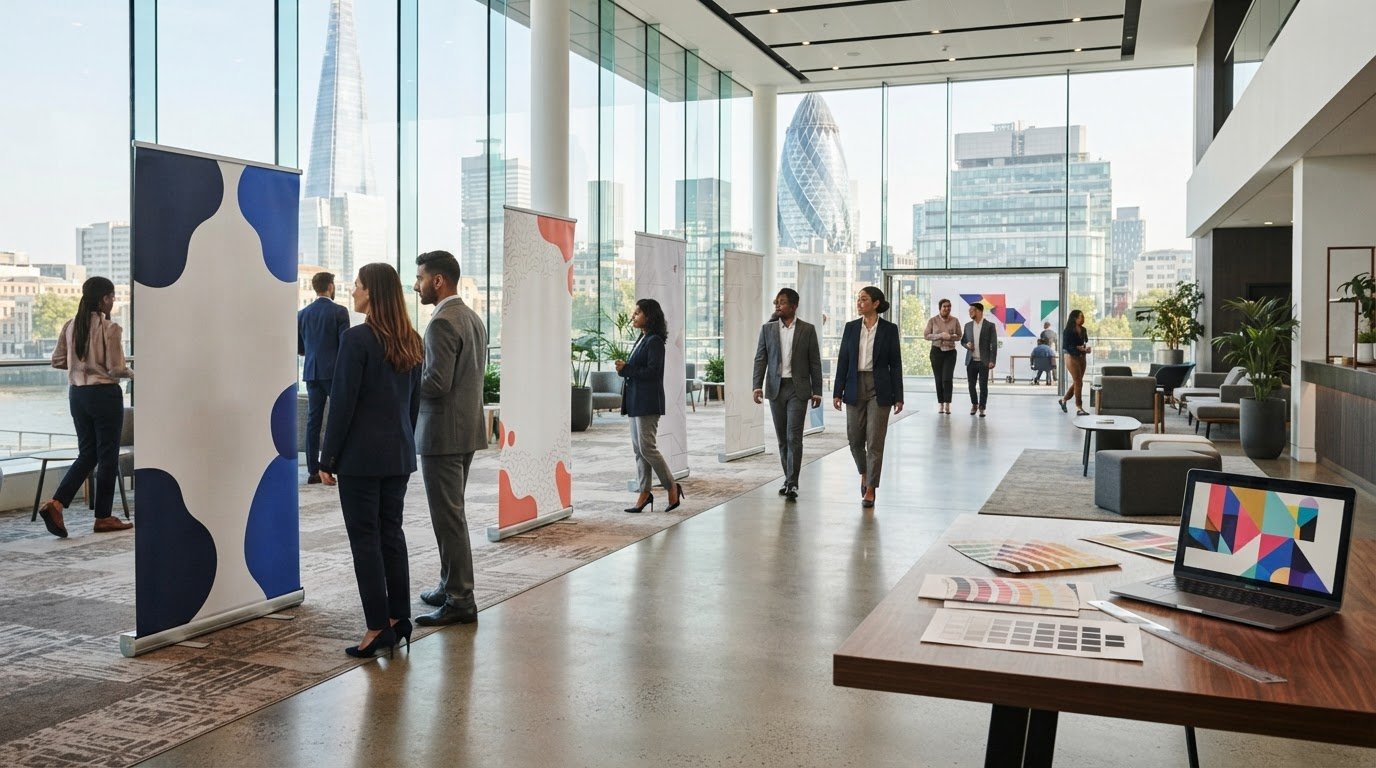
A pull-up banner can catch attention across a busy venue or disappear into the background. For pull up banners London audiences can read clearly, choose a format, message and artwork that suit the space and viewing distance.
If you’re preparing for an event, you may already know what you want to communicate. The next steps are to select a format for your space, prepare artwork to the correct specifications and plan production around your event date. Clear decisions early on help avoid last-minute changes.
This guide covers how to choose a banner for your objective, prepare print-ready artwork and organise your brief. You’ll find practical guidance on dimensions, CMYK colour setup, bleed and high-resolution PDFs, plus checks that can catch file issues before printing. London City Print is an independent Central London printer, operating since 2009, and offers roller banners and large-format printing. Use the steps below to prepare a clear brief for your event display.
Key Takeaways
- Match your banner’s role to the audience, viewing distance and venue layout before settling on a format.
- Give your design a clear reading order, with one main message and a simple next step for viewers.
- Plan the display around the available floor space and the direction visitors will approach from.
- For pull up banners london, prepare a concise production brief with the quantity, display location, artwork status and event date.
- Use pre-flight file checks to help catch artwork issues before production.
Pull-up banners in London: start with the event and its audience
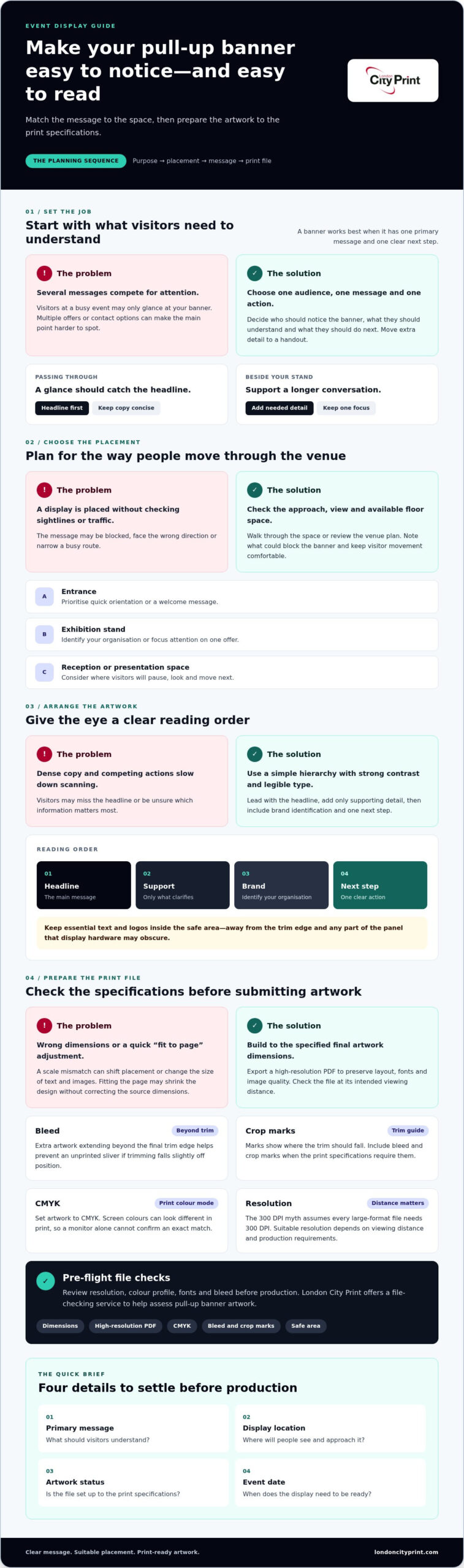
Visitors at a busy event have little time to work out what your organisation offers. Before choosing a format or writing copy, decide what the banner needs to do. Who should notice it, what should they understand, and what action should they take next?
A pull-up banner is a portable display for temporary event messaging. It might direct visitors, introduce a service or help them identify your stand. Start with the event objective, then account for the audience and space around the display.
What should a pull-up banner achieve at an event?
Choose one primary message. A banner welcoming visitors to your stand has a different job from one directing attendees to registration. Consider what the audience already knows. People familiar with your organisation may recognise a service name, while first-time visitors may need a plain-language description.
Let viewing distance guide how much information you include. Someone passing through a crowded entrance may only glance at the headline. A visitor beside your stand can take in more detail. Several competing calls to action make it harder to see what matters, so focus the banner on one clear action. Put additional information in a handout that visitors can read at their own pace.
For example, if you’re introducing a consultancy service, lead with its name and a concise benefit, then invite visitors to speak with your team. Avoid unrelated service descriptions and multiple contact options that dilute the invitation.
Where will London event visitors see the banner?
Map the display location before you settle on the message. An entrance banner may need to orient people as they arrive; a stand banner can reinforce your offer to visitors who are already browsing. Reception areas and presentation spaces have different sightlines and foot traffic. The role of trade show displays varies by setting, so plan around how people will approach and move past yours.
Walk through the space, if possible, or review the venue plan. Note the direction visitors will face, what could block their view and how much floor space surrounds the display. A banner beside a busy walkway should communicate at a glance without narrowing the route. One inside a stand can support a longer conversation. Keep sightlines clear and leave enough room for people to move comfortably.
- Entrances: Prioritise quick orientation or a welcome message.
- Exhibition stands: Identify your organisation or focus attention on one offer.
- Reception and presentation spaces: Consider where visitors will pause, look and move next.
Decide what visitors should notice first, then place the banner where that message can reach them. This gives your display a clear purpose before you prepare the artwork.
Pull-up banner artwork: organise the message before preparing the file
Banner artwork needs to work as both a message and a print file. A clear design can lose impact if text sits in a trim area, the page dimensions are wrong or the colour setup doesn’t suit print. Plan the reading order first, then build the artwork to the print specifications.
File readiness depends on correct dimensions, bleed, resolution and colour setup. Check these details before submitting your artwork to help prevent avoidable file problems.
How should the banner message be arranged?
Use a simple visual hierarchy so visitors can understand the display quickly. Put the headline first, add only the supporting detail needed to make the message clear, then include your brand identification and one next step. Short copy, strong contrast and legible type help key information stand out. Dense paragraphs and competing actions make a banner harder to scan.
Keep essential text and logos inside the safe area, away from the trim edge and any part of the printed panel that the display hardware may obscure. Check the reading order at the intended viewing distance, not only in a close-up view on screen. Move details that aren’t essential to the first impression to a handout or other event material.
Which print-file details prevent avoidable artwork problems?
Build the design to the final artwork dimensions specified for the banner. A file at the wrong scale can affect placement and make text or images appear at an unintended size. Export a high-resolution PDF to preserve the layout, fonts and image quality for print. Don’t use “fit to page” to correct a size mismatch. It may shrink the design without fixing the underlying dimensions.
Bleed is extra artwork that extends beyond the final trim edge, helping prevent an unprinted sliver if the finished piece is trimmed slightly off position. Crop marks show where the trim should fall. Keep vital text and logos within the safe area, and include bleed and crop marks when the print specifications require them.
Set the artwork to CMYK, the colour mode used for print. Screen colours can look different from printed colours, so don’t rely on a monitor alone to judge an exact match. Follow the print specifications for the correct dimensions, colour profile and file setup.
The 300 DPI myth is the assumption that every large-format banner file needs 300 DPI. Suitable resolution depends on viewing distance and production requirements, so follow the specifications and check image quality before enlarging artwork. Pre-flight file checks can review resolution, colour profile, fonts and bleed before production. London City Print offers a file-checking service to help assess artwork for pull-up banner printing.
Which pull-up banner format suits your event and display space?
Choose a format by considering how visitors will approach the display, how much floor space you have and what the banner needs to communicate. A narrow stand beside a wall has different needs from a display where people pass on both sides. For pull up banners london events, start with the venue plan and visitor flow, then compare display options against the available space.
Use this guide to frame the choice. Base your artwork and layout on the selected product’s dimensions and stand specifications.
| Event setting | Viewing direction | Space and message purpose |
|---|---|---|
| Exhibition stand beside a wall | Mostly from the front | A single-sided display can direct attention to one offer without using space behind the stand. |
| Stand beside an open aisle | Visitors may approach from either direction | A two-sided display can carry a message on both faces when the space allows. |
| Reception or registration area | Visitors approach from a planned route | A clear directional or welcome message can help people orient themselves. Keep the display clear of circulation routes. |
| Small counter or tabletop setting | Visitors view the display from nearby | A compact display may suit a short message at close range. Check its dimensions and specifications against the available space. |
| Outdoor event area | Approach and conditions vary | Treat this as a separate display requirement. Don’t assume a standard indoor stand is suitable for outdoor conditions. |
When is a single-sided or double-sided display useful?
A single-sided banner often suits placement against a wall or at the edge of a display area, where visitors see the front from one main direction. A two-sided display may help when people approach from opposite directions, such as along an open aisle. It adds value only when both faces have a clear purpose and remain visible within the venue layout.
Check the sightlines before choosing. A second printed face won’t help if a wall, neighbouring display or stand position blocks it. Match the configuration to visitor movement rather than choosing a feature the space won’t make useful.
How do venue and viewing distance affect format selection?
Measure the display area and note stand width, nearby exhibits and the space visitors need to move through. A large graphic may be difficult to place in a confined reception area, while a compact option may not give a headline enough presence across a wider space. Viewing distance also affects how much content visitors can comfortably read.
For outdoor use, assess the location and display requirements separately before selecting a format. If you’re comparing a freestanding banner with a wall-mounted graphic, large-format poster printing offers another way to plan a display around the venue and available surfaces.
Prepare a London pull-up banner order with fewer production delays
A fixed event date leaves little room for unclear specifications or artwork revisions. Give your printer a complete brief so the display format, file and schedule can be considered together. For pull up banners london events, work through these steps before submitting your order.
- Confirm the event details. Record the event date, venue, delivery or collection requirements and intended display location.
- Select the format. State the quantity and where visitors will see the display. Include the final dimensions and relevant stand specifications.
- Prepare the artwork. Submit the approved file and state whether the artwork is final or still in progress.
- Submit one clear brief. Include a project contact who can answer questions promptly. Make the event date and instructions easy to find.
What information should your print brief include?
Bring the project details together before submitting your request. State the quantity, venue, required event date, intended placement and delivery or collection requirements. Attach the approved artwork, final dimensions and relevant stand specifications rather than relying on assumptions about size or fit. Mark the artwork status clearly and name a contact who can respond to questions or approve changes.
A single point of contact keeps instructions consistent. If the venue schedule creates a deadline constraint, flag it early so it can inform production planning.
How can pre-flight file checks help protect the schedule?
Pre-flight file checks can flag technical issues before production, giving you time to resolve them and provide an approved file. London City Print offers a file-checking service to assess submitted artwork. Addressing file questions early can reduce avoidable back-and-forth.
London City Print offers same-day service for most professional documents. Include your event date and requirements in the brief so the production plan for your roller banner can be set out clearly.
Before you submit, make sure the quantity, dimensions, file status and deadline are clear. Share your pull-up banner brief with London City Print, including your event date and delivery or collection requirements.
Order pull-up banners in London with a clear production brief
A clear production brief connects your event requirements with the artwork and display you need. London City Print produces roller banners for event organisers who want to plan their display and submit technically prepared artwork. A concise, accurate brief keeps the project details together from the start.
For pull up banners london projects, put the essentials in one message. Include the event date, intended use, quantity and artwork status, then add the relevant specifications and delivery or collection requirements.
What makes a print brief easier to action?
State the event date, venue and intended display location. Include the banner’s final dimensions and relevant stand information, along with the quantity required. Attach approved artwork or explain whether the file is still in progress. If the venue schedule creates a deadline constraint, flag it early so it can inform production planning.
Designate one project contact who can answer questions and approve changes. This keeps instructions consistent and avoids delays while decisions pass between several people. A clear brief gives the production team the details needed to plan the work.
How does London City Print support event printing?
London City Print offers roller banners and large-format printing up to A0 size and beyond. The large-format capability applies to the wider print service, not as a specification for banner dimensions. Prepare your brief around the selected banner’s product details so the artwork matches the format you need.
Pre-flight file checks and the file-checking service can help identify artwork issues before production. Include your event date and requirements in the brief to keep the production plan clear.
Before submitting, make sure your file status, dimensions, quantity and event deadline are clear. Send London City Print your pull-up banner requirements with a concise brief.
Put your event display plan into action
Your banner’s role continues after it leaves the printer. Give your event team a simple handover: where to place the display, which audience it should reach and what response it should prompt. This connects the printed message to the way you welcome and guide visitors on the day.
For pull up banners london events, treat the approved artwork as part of your wider event communications. Keep the final file and placement details together so your team can refer to the same version when preparing the venue. A clear handover helps everyone use the display with purpose, even when setup moves quickly.
When you’re ready to move from planning to production, prepare your event date, intended use and banner requirements. Send your event display requirements to London City Print to start your order with a clear brief.
Frequently Asked Questions
Is a pull-up banner the same as a roller banner?
Yes, “pull-up banner” and “roller banner” commonly describe a portable display with a graphic that retracts into its base. The names can vary, so focus on the display’s dimensions, stand details and artwork requirements. If you’re ordering a replacement graphic or matching an existing display, use the stand’s exact product information to avoid a fit mismatch.
Can pull-up banners be used outdoors?
Use a banner outdoors only if its materials and stand are intended for the conditions at your event. Don’t assume an indoor display can handle wind, rain or direct sun. Assess exposure, ground conditions and how the display will be secured, then choose equipment designed for that setting. If the event moves between indoor and outdoor areas, plan for the more demanding environment.
Can I replace the graphic on a pull-up banner stand?
Replacement depends on whether the stand accepts a separate graphic and whether the new panel matches its dimensions and fitting method. Identify the stand model and review its specifications before preparing a new file. A graphic that looks correct on screen can still be unsuitable if its width, height or attachment details differ. If you can’t identify the model, photograph its labels and fittings for reference.
How should I store a pull-up banner after an event?
Retract the graphic carefully and avoid forcing it if it catches. Make sure the display is clean and dry before storage, and use its protective case if one came with the product. Store it in a secure place where heavy items won’t press against or bend the stand. Follow the manufacturer’s care instructions, especially after using the display in a dusty or damp venue.
How many pull-up banners do I need for an exhibition stand?
There’s no fixed number for every stand. Start with the space, visitor routes and messages you need to communicate. One banner may be enough to identify a compact stand, while separate areas or approaches from different directions may call for more than one display. For pull up banners london exhibitors plan to use, map the stand and mark each banner’s purpose before deciding on quantity.
Can one pull-up banner design work for different events?
Yes, if the core message remains relevant and the design doesn’t depend on event-specific details. A brand introduction or evergreen service message may suit several occasions. Review the graphic before each event and update details such as dates, venue information, contact details or a QR code destination. Check that the call to action still fits the audience and that the printed information remains current.
What should I check before sending pull-up banner artwork to print?
Check that the file uses the correct final dimensions and matches the stand’s specifications. Review the headline, contact details and any QR code at full size, then test the code with a phone. Confirm that images look clear at the intended display size and that fonts and linked elements appear correctly in the exported PDF. A final review by someone who hasn’t prepared the artwork can catch overlooked errors.