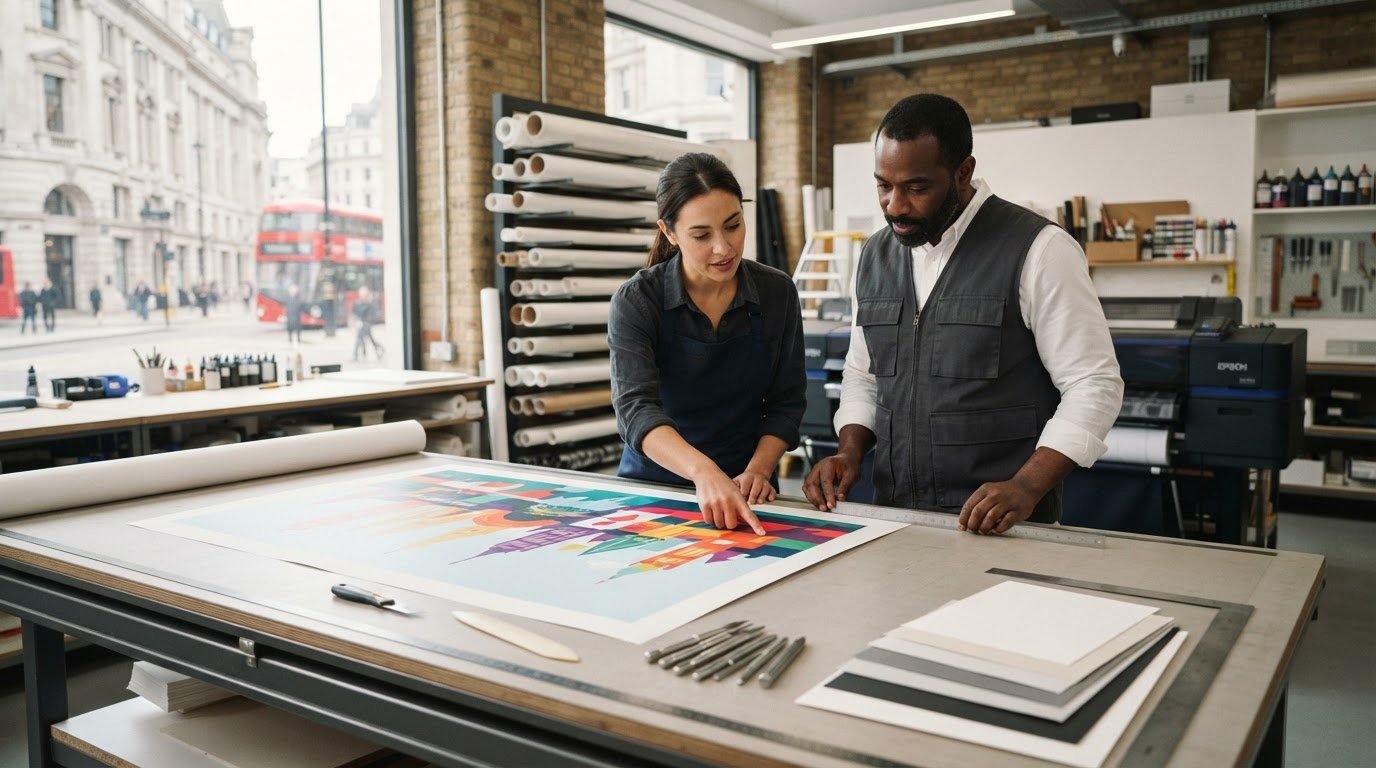
The largest poster isn’t always the clearest choice. For large format poster printing london, the right result depends on how far away people will view it, where it will be displayed and whether your artwork is ready to print.
You may know the size you need but still be weighing up paper stock, finish and image quality. You also need to know whether file checks, production and handover can fit your schedule. This guide explains how to match poster specifications to the display environment, prepare print-ready artwork and confirm details that could affect your deadline.
We’ll cover viewing distance, dimensions, stock and finish, along with practical file checks such as image resolution, CMYK colour and bleed. You’ll also find questions to ask your print partner about materials, poster-specific turnaround, collection or delivery, and file checking before you place an order. London City Print offers large-format printing from its Central London facility near the British Museum. Confirm the options available for your poster and deadline before production begins.
Key Takeaways
- Choose poster dimensions based on viewing distance, available display space and the amount of detail viewers need to read.
- Compare matt, gloss and satin finishes against the display lighting, and confirm available paper weights and stocks before ordering.
- Prepare a high-resolution PDF to the printer’s specifications, checking dimensions, bleed, crop marks, fonts and colour profile.
- When comparing large format poster printing london providers, confirm file acceptance, the production schedule and collection or delivery arrangements.
- Ask whether your poster specification qualifies for the supplier’s stated turnaround, including any same-day service.
How to choose large format poster printing in London for your purpose
Start with the job your poster needs to do. An event poster may need a clear date, venue and call to action. A retail display might prioritise a product image and short message, while office communication may need information people can read while standing nearby. Posters can serve many purposes; for background on what is a poster and how posters are used, see the reference overview.
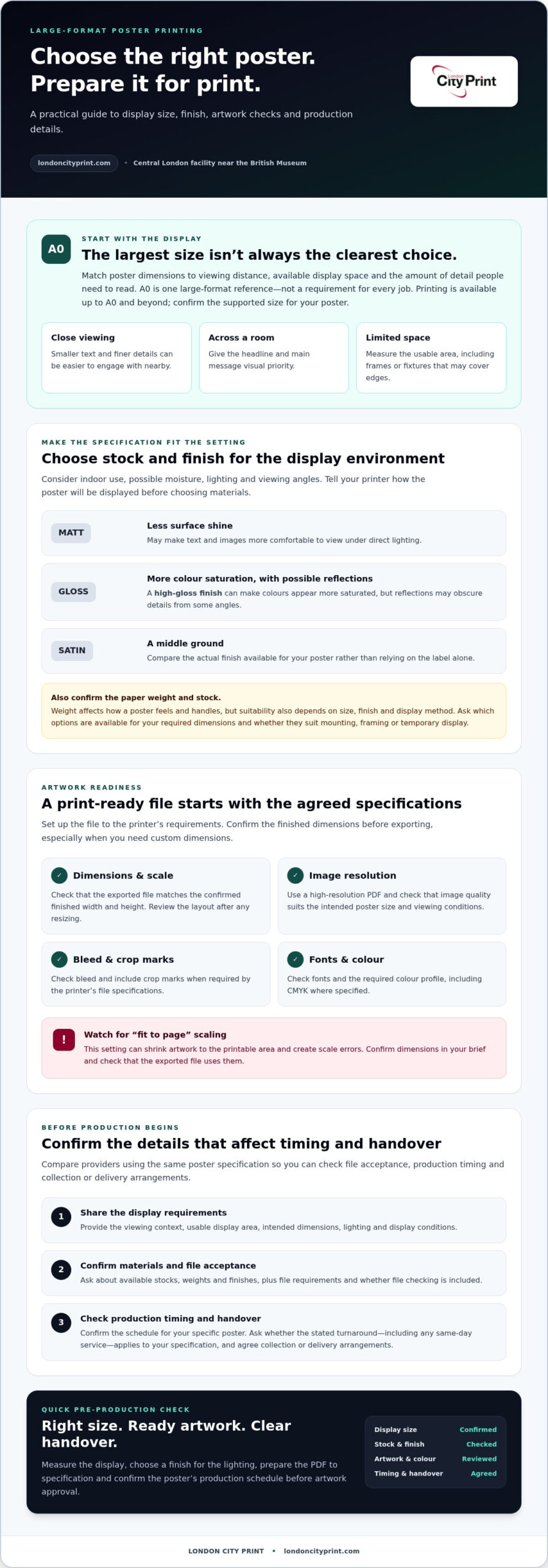
For large format poster printing london, choose dimensions to suit the audience and display, not simply the largest format available. Measure the wall or display area, then consider how far away viewers will stand and how much detail they need to read. This helps you balance visibility, legibility and available space before designing the artwork.
Which poster size suits your display and viewing distance?
People reading a poster up close can engage with smaller text and finer detail. If viewers will see it across a room or venue, prioritise a strong headline and simple visual hierarchy. A0 can be a useful reference for a large display, but it isn’t necessary for every job. A smaller standard format may suit a confined wall or a message with limited content.
Measure the usable display area, including frames or fixtures that could cover the edges. Confirm the finished width and height with your printer before exporting the artwork. London City Print offers large-format printing up to A0 and beyond, but confirm supported sizes for your specific poster job.
When should you specify custom dimensions?
Custom dimensions may suit an unusually proportioned display, a narrow wall space or a layout designed for a particular frame. Before designing, ask the printer to confirm production limits and the exact finished dimensions for the requested stock. This lets you set up the artwork correctly from the start.
Don’t assume a file will retain its intended proportions if it is scaled to fit. The fit to page setting can shrink artwork to match a printable area and create scale errors. Resizing can also affect the layout, including text size and the position of key elements. Include the agreed dimensions in your brief and check that the exported file matches them.
For more detail on standard formats and large-format production, read the large format poster printing guide. Use it alongside your measurements, then confirm the final size with your print partner before approving the artwork.
Which poster stock and finish suit your London display?
The right poster specification depends on where it will be displayed and how people will view it. A poster in a brightly lit shop window faces different conditions from one on an office wall. Before choosing a finish or stock, note whether you plan to display it indoors, expose it to moisture or place it under strong lighting. Share those details with your printer to check which options suit the job.
Posters can carry practical messages and make a visual impression. The Victoria and Albert Museum’s extensive poster collection shows how design and communication work together. For your own display, consider how the finish affects the artwork’s appearance and how it looks in the room.
How do matt, gloss and satin finishes differ?
A matt finish reduces surface shine, which can make text and images more comfortable to view under direct lighting. A high-gloss finish can make colours appear more saturated, but it may also create reflections that obscure details from some viewing angles. Satin sits between the two in appearance. Ask which finish is available for your poster rather than relying on the label alone.
Think about the lighting and viewing angles where the poster will hang. Gloss may suit artwork where colour impact matters and reflections are manageable. Matt may work better where people need to read information under bright lights. Satin can offer a middle ground. No finish is best for every display, so describe the environment and the result you want before confirming your choice.
What should you confirm about paper weight and display conditions?
Paper weight affects how a poster feels and handles, but it doesn’t determine suitability on its own. Size, intended display method and finish matter too. Ask which weights and substrates are available for your required dimensions and finish, and explain whether you plan to mount, frame or temporarily display the poster.
If the display may encounter moisture, confirm that the proposed stock is suitable. Don’t assume paper or a particular finish is water-resistant unless the printer confirms it for that specific option. Check the same way if strong lighting could affect the print’s appearance.
If sustainability matters to your organisation, ask whether recycled or certified paper options are available for the selected poster size and finish. Check the specification directly with the printer before proceeding. You can also review London poster printing options.
Will your large format poster print sharply? Check the artwork before ordering
A sharp poster starts with artwork set up for its final dimensions. For large format poster printing london, ask your printer for the required file format, resolution, colour profile and bleed before exporting. A high-resolution PDF can preserve the layout and fonts, but it still needs to meet the printer’s specifications.
A large poster needs enough effective resolution at its final printed size, with the right level depending on how close viewers will stand. The 300 DPI myth suggests every large print needs 300 DPI, but requirements vary with viewing distance and print workflow. As a general guide, if people view the artwork from around 2 to 5 metres, it may need 100 to 150 DPI at final size. For close viewing under 1 metre, it may need 150 to 300 DPI. Confirm the target with your printer before preparing the file.
What should a pre-flight file check cover?
Check the file at the agreed finished dimensions, then review the technical details that can affect trimming and output:
- Bleed: Extend background colours or images beyond the trim edge by the amount your printer specifies.
- Crop marks: Add them only if requested, and position them to indicate the intended trim size.
- Fonts: Embed fonts in the PDF or follow the printer’s instructions for handling them.
- Images: Check effective resolution at the final size, especially if you enlarged or cropped source images.
Ask whether the printer offers a file-checking service or pre-flight file checks, and confirm what each check covers. Avoid using fit to page unless the printer approves it. This setting can shrink artwork to fit a printable area, changing the intended scale and potentially affecting the layout or text size.
How should you prepare colour and images for print?
CMYK is the colour model used for standard process printing. Screens often display colour differently, so confirm the required colour profile and conversion settings with your printer. Don’t treat a screen preview as a guarantee of the final printed colour. If the printer offers a proof for your job, ask how to review it before approving production.
Finally, inspect images at the intended print dimensions. A photo that looks clear on a laptop may appear soft when enlarged. Confirm the final page size, bleed and colour profile in the exported PDF, then ask the printer to verify that the file meets its requirements before production.
How to compare London poster printers for deadlines, quality and collection
A reliable order depends on more than a headline turnaround. For large format poster printing london, compare how clearly each supplier confirms your file requirements, exact specification, production schedule and handover plan. A specific answer about your poster is more useful than a general promise about speed.
Before requesting a schedule, have these details ready:
- Finished dimensions and quantity: State the final size and how many posters you need.
- Stock and finish: Share your preference, or ask what’s available for that size.
- Artwork status: Confirm the file format and whether it’s ready for print or may need correction.
- Required handover date: Give the date you need the posters in hand, not just the date you hope to place the order.
What should you confirm before relying on a print deadline?
Ask the printer to confirm whether your exact combination of size, quantity, stock, finish and artwork can meet the required date. London City Print offers rapid turnaround for a range of print requirements, but confirm whether your poster specification and file can meet your deadline. Allow time for any file corrections and approval steps the printer says your order needs. Get the production schedule confirmed before committing to a display date.
For wider context on choosing a supplier, read about professional printing services in London. Use that background alongside job-specific questions about file acceptance, available specifications and production timing.
Which handover details matter for a London order?
Confirm whether collection or delivery is available for your specific order. If you plan to collect, check the handover location, contact arrangements and when the order will be ready. If you need delivery, ask the printer to confirm the available option and expected timing directly. Don’t assume a service, location or schedule until the supplier confirms it.
London City Print is based near the British Museum in Central London. If you’re arranging a handover nearby, confirm collection availability and timing for your poster order. For general information about London City Print poster printing, contact the team with your dimensions, quantity, stock preference, artwork status and required date. These details help the printer check the specification and explain the next steps.
Order large format posters from London City Print with fewer production surprises
A clear brief helps the printer confirm whether your poster can be produced to the required specification and schedule. Define the poster’s purpose, settle the dimensions and display conditions, then confirm stock, finish and file requirements. Before approving the job, check the production schedule and handover arrangements directly with the printer.
London City Print offers large-format printing from its Central London facility near the British Museum. If you’re considering large format poster printing london, confirm that the size, stock and finish you need are available for your specific job. Ask which materials and finishes are suitable for the display conditions before including them in your brief.
What information should you include in a poster enquiry?
Give the printer enough detail to assess the job without guessing. Include:
- Final dimensions and the quantity you need.
- Where the poster will be displayed, including relevant lighting or moisture exposure.
- Your preferred stock and finish, or a request for suitable available options.
- The required handover date and whether you want to ask about collection or delivery.
- A high-resolution PDF, if ready, plus any questions about resolution, bleed, crop marks, fonts or colour profile.
If you’re still preparing the artwork, say so. Ask which file specifications to follow and whether file checking is available for your order. Clear questions at this stage can help resolve technical details before the file reaches production.
What happens after you submit the poster brief?
Ask the printer to confirm the agreed dimensions, quantity, stock, finish, file readiness and production arrangements. If artwork amendments remain, resolve them before approving the job. Check that the final file matches the confirmed specification, then verify the required handover date and collection or delivery details. Don’t assume poster-specific availability or timing based on general service information.
This approval step gives you a chance to catch mismatched dimensions, missing bleed or an unconfirmed stock choice before production proceeds. Keep the confirmed specification and schedule together so everyone working on the display has the same details.
Ready to discuss your poster brief? Contact London City Print with your dimensions, quantity, display conditions, artwork status and required date. The team can confirm which options and production arrangements apply to your poster.
Get your poster brief ready for print
Successful large format poster printing london starts with a clear purpose, dimensions suited to the display and a stock and finish matched to the environment. Prepare a high-resolution PDF to the printer’s specifications, then check dimensions, bleed, fonts and colour profile before approval. Confirm the poster options, production schedule and handover arrangements with your print partner.
Confirm which specifications and production options are available for your poster, including whether your required handover date can be met.
Have your size, quantity, display conditions, artwork and required date to hand. Contact London City Print to discuss your poster requirements and confirm the details before placing your order. A precise brief and clear production checks help you prepare your display with fewer surprises.
Frequently Asked Questions
Is A0 the right size for a large format poster?
A0 can suit a display that needs to attract attention from a distance, but it won’t fit every space or brief. For large format poster printing london, measure the wall or stand and consider how far away people will view the poster, along with how much detail they need to read. Confirm the final dimensions and available production options with your printer before preparing or exporting your artwork.
Can any image be enlarged for poster printing?
No. Some images lose clarity when enlarged. The result depends on the source image, its resolution at the final printed dimensions and how far away people will view the poster. Check image quality at the intended print size, not just on your screen. Ask the printer to confirm its file requirements, and don’t assume a small image will stay sharp simply because you place it on a large page.
What resolution do I need for a large format poster?
There isn’t one resolution that suits every poster. The right setting depends on the final dimensions, viewing distance, image content and print workflow. The 300 DPI myth is a reminder not to apply one figure to every large-format job. Prepare a high-resolution PDF where suitable, then confirm the printer’s resolution and file requirements before exporting your final artwork. This helps you avoid unclear images and unnecessarily large files.
Which poster finish is best for bright lighting?
The best finish depends on how you’ll light and view the poster, along with the artwork and intended appearance. A high-gloss finish can increase colour saturation, but direct lighting may create reflections that make details harder to see. Matt or satin may suit some brightly lit spaces better, but neither is automatically right for every display. Confirm which finishes the printer offers for your poster size, and ask for guidance if glare concerns you.
Can I get large format poster printing in London the same day?
Same-day availability depends on your poster specification, artwork readiness and the printer’s production schedule. Share your dimensions, quantity, file and required date with the team, and ask whether they can complete your specific job by the deadline. Wait for confirmation before planning around a handover time.
Can a poster be printed in custom dimensions?
Yes, custom dimensions can suit a display area or layout that doesn’t match a standard format, but confirm production limits before you design. Ask the printer to verify the finished dimensions for your chosen stock and finish. Include bleed if required, and don’t use fit to page without checking. Automatic scaling can change the intended print size or proportions, affecting the layout and position of important details.
What file should I send for poster printing?
A high-resolution PDF can preserve layout, fonts and image quality, but first confirm the printer’s accepted file specifications. Check the page dimensions, bleed, crop marks, embedded fonts and colour profile before submitting the file. Make sure images remain clear at the final print size. If you’re unsure about any setting, ask whether the printer offers pre-flight file checks or a file-checking service before production.