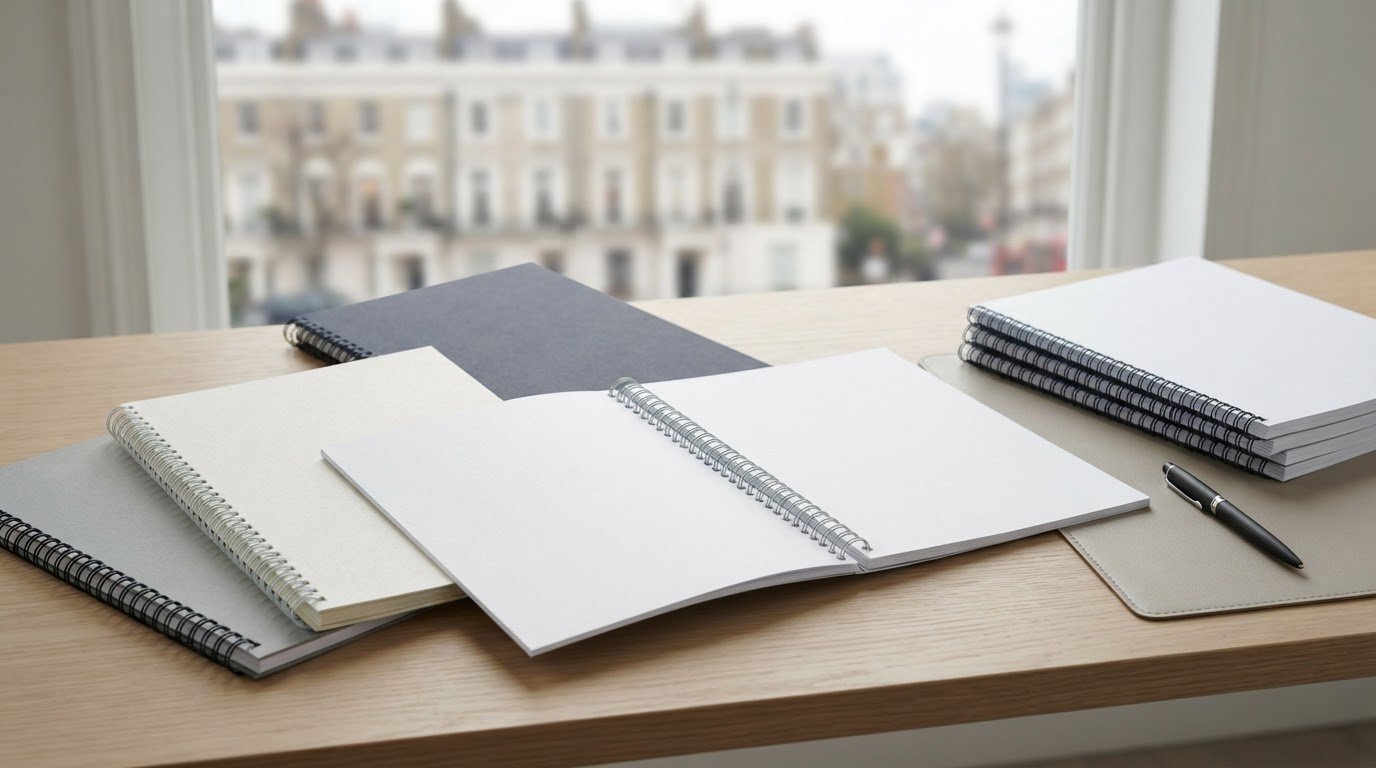
Wire spiral binding gives working documents a professional finish and lets them lie flat for easy reference. With wire binding services in London, choose a format based on how you’ll use the finished document, its page count and the materials selected. Wire binding uses a plastic-coated or metal wire comb to hold the pages together.
For a presentation, report or booklet, appearance matters, but so do handling and durability. Choose a format that suits the document, keeps its pages together and works for the people who will read it.
This guide explains how wire spiral binding works, outlines the binding choices and shows which project details shape a quote. You’ll also learn what to prepare for production and how a print service can help produce your document accurately and on schedule.
Key Takeaways
- See how wire spiral binding holds pages together and lets a document lie flat for easier reference.
- Learn which document details, including format and page count, to consider when selecting a binding option.
- Find out what project requirements can affect a binding quote without relying on generic price assumptions.
- Understand why order details and production requirements matter when planning a deadline.
- Explore how wire binding can support booklets and brochures prepared for professional use.
Wire spiral binding in London
Wire spiral binding holds loose pages together with a metal wire comb, letting the finished document lie flat. In London, it suits materials that readers need to open, review and refer to repeatedly.
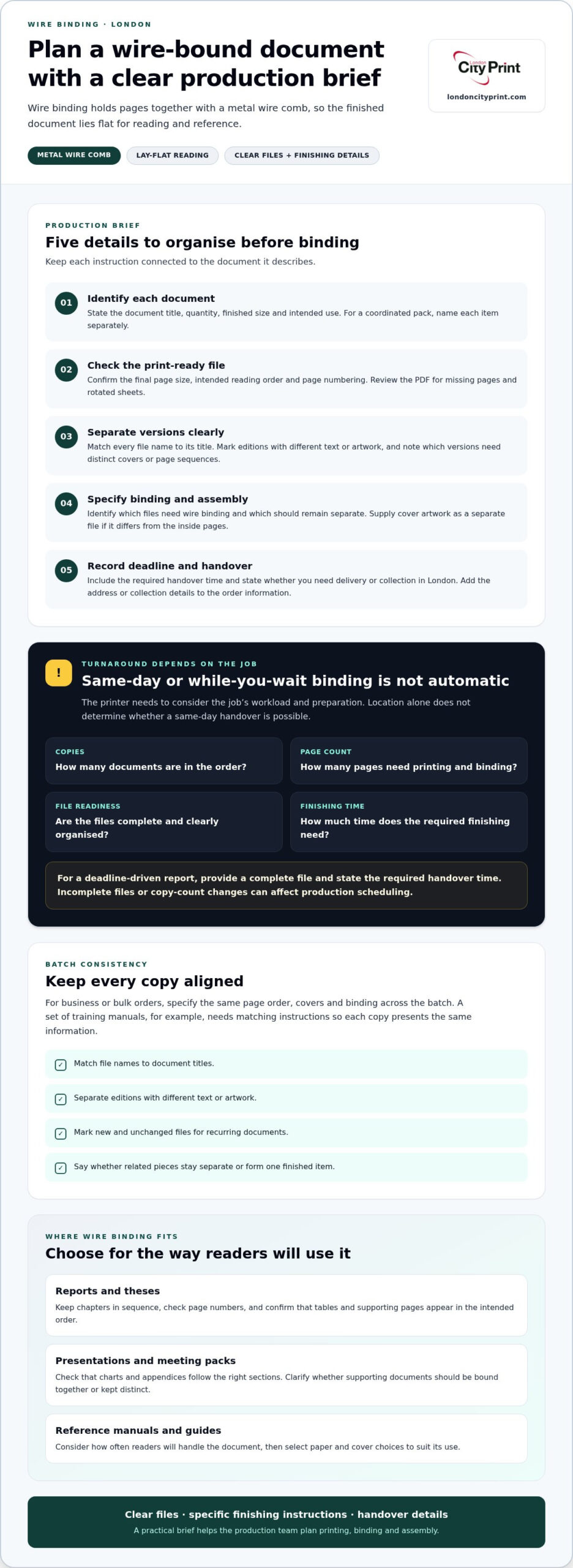
For bulk or business orders, choose a service that can keep the specification consistent across the batch. A set of training manuals, for example, needs matching page order, covers and binding so every copy presents the same information. Provide the quantity, finished size and file versions together to keep production instructions clear.
Yes, you can order wire binding online by supplying print-ready files and clear job instructions. State whether you need delivery or collection in London, and include the delivery address or collection details in your order information. A presentation pack, for example, may need separate file names for each document in the batch.
Before submitting a PDF, check that pages are in the intended reading order and that the document has the correct final page size. Include cover artwork as a separate file if it differs from the inside pages. These steps help the printer understand the document’s structure before binding starts.
Order Turnaround and Same-Day Binding
Same-day or while-you-wait binding depends on the job’s workload and preparation, not simply its location in London. The printer needs to account for the number of copies, the page count, file readiness and time required for finishing. For a deadline-driven report, submit a complete file and state the required handover time when placing the order.
Include the deadline and handover details with your order, especially when a batch contains several documents. An incomplete file or a change to the copy count can affect production scheduling. Clear instructions give the team the information needed to plan printing, binding and handover.
Wire spiral binding services in London can suit business documents that need a practical, lay-flat format. A client presentation, internal procedure guide or event handout may each call for a different cover and page sequence. Decide whether readers will handle the document frequently, then select paper and cover choices to suit its use.
Theses, Presentations, and Reports
Wire binding can organise a thesis, presentation or report into a single document that opens flat for reading. For a thesis draft, keep chapters in sequence and check page numbering before sending the file. For a client presentation, confirm that charts and appendices follow the relevant sections.
Reports often combine text, tables and supporting material. Review the final PDF for missing pages, rotated sheets and correct reading order. A clear file structure helps the printer assemble the document accurately and makes the finished copy easier to use in meetings or reviews.
For any London order, prepare the final file, define the quantity and clarify the handover method. Those details help match the binding workflow to your document, whether you need presentation copies or a coordinated business batch.
Binding prices
A clear production brief tells the printer exactly how each document should be finished. Treat it as a job specification, especially when one order includes several titles. A project pack with a client report, agenda and reference sheet should identify each item separately, rather than grouping every file under one general label.
For a multi-version job, create a schedule matching file names to document titles. Record which versions share the same layout and which need distinct covers or page sequences. For example, a sales team may need separate regional editions with different contact details. A version schedule reduces the risk of mixing artwork during production.
State how the finished documents will be used. A reference manual for repeated desk use has different handling needs from a presentation distributed at a single meeting. That purpose can guide choices about presentation and finishing. Include the intended use in the brief, particularly when the audience will receive several related pieces.
Before sending an order, organise the job information in one place:
- Match every file name to its document title.
- Separate editions that contain different text or artwork.
- Identify which pieces belong together as a set.
- Describe the audience and intended use for each item.
- Keep any production instructions with the files they describe.
For recurring documents, retain a record of the approved version and its identifying details. A meeting pack that returns each quarter, for example, may use a revised agenda alongside unchanged reference material. Mark new and unchanged files clearly so the production instructions reflect the current edition.
Review the final set as a reader would. Check that titles, section labels and supporting pages form a logical sequence. If a pack contains a main report and separate supporting documents, state whether they should remain distinct or form one finished item. Clear grouping instructions prevent ambiguity during assembly.
A well-organised brief gives the production team a practical route from files to finished documents. Keep the file schedule, edition notes and intended use aligned. That preparation supports a consistent result across a single document or coordinated set, without leaving finishing decisions open to interpretation.
Price information can help make finishing instructions more specific when a document needs binding. Include the binding choice in your production brief, and make clear which files need binding and which pieces should remain separate. This ensures the requested finish is matched to the right document.
When preparing the job details, include the binding choice alongside the document title and intended use. Identify a thesis or dissertation clearly, and match each wire-bound document to its file. Keep those instructions with the relevant artwork and edition notes. This makes the finishing request easier to follow and helps distinguish bound items from other materials in a coordinated pack. If a job includes several documents, state the binding requirement for each one rather than assuming the same finish applies throughout.
Wire binding
Wire binding uses a plastic-coated or metal wire comb to hold pages together and let the document lie flat or fold back. Match your choices to the document’s purpose, appearance and print files.
Paper, Covers, and Wire Choices
Paper weight and surface affect how a finished document feels and handles. For example, a text-heavy report may suit uncoated pages, while photographs can benefit from a smoother stock. A cover can use heavier paper than the inside pages, helping distinguish it from the contents.
Wire colour is a visible finishing choice. Specify your preference alongside the cover design and page stock, and confirm the available options before approving artwork. This helps the wire complement the finished document rather than clash with its cover.
Document Sizes and Page Counts
The document’s finished size and page count are useful details when selecting a suitable wire binding. A portrait report and a landscape presentation have different edge dimensions, even if both use the same paper stock. Provide the final trim size and total pages, including covers, when preparing your specification.
Page count also affects the thickness of the bound edge. A short meeting handout and a long reference document need different wire capacities. Keep the final page sequence intact, and include inserts or blank pages in the count. This lets the production team assess the complete document, not an incomplete draft.
Files and Print Specifications
Supply a high-resolution PDF with pages in the intended reading order. Check that the file uses the final page size and that artwork reaches the trim edge where needed. Include crop marks when your file setup requires them, and keep important text clear of the binding edge.
State whether pages print in colour or black and white, and identify any different cover artwork. For example, a report with a full-colour cover and monochrome charts needs a clear production note. Review the PDF before sending it, especially for page orientation, numbering and missing images.
Wire binding differs from plastic spiral binding, comb binding and perfect binding by its closure and spine. Metal wire forms paired loops through punched pages, while plastic spiral uses a continuous coil. Comb binding uses a row of teeth that opens along the spine. Perfect binding joins pages at a flat spine with adhesive, giving the document a book-like edge.
Choose based on how readers will use the document. A presentation that needs to lie flat can suit wire or coil binding. A document that needs a flat printed spine may suit perfect binding instead. Comb binding can suit pages that need to be rearranged, depending on the specific comb and production setup.
For a well-prepared order, send the final PDF, confirm the finished size and page count, then specify paper, cover and wire preferences. Include a sample page description when the document mixes charts, photographs and text. These details help align the printed contents and binding finish with the purpose of your report or presentation.
What document sizes and page counts can London wire binding services handle?
Document size and page count depend on the printer’s equipment and job specification. A portrait report, landscape training manual and custom-size presentation each need different setup. Give the finished width and height, page total and orientation when requesting wire binding. These details let the production team assess the document as a complete job.
Page count affects the thickness of the paper stack, which guides the wire size. A short handout and a thick reference guide cannot use identical binding specifications. Count every printed side as a page, then include covers, inserts and blank pages in your final total. This avoids sizing the wire against an incomplete document.
Unusual formats need particular attention. For example, a landscape catalogue may have a long binding edge, while a compact portrait guide has a shorter one. If your design uses custom dimensions, state them clearly rather than relying on a screen preview. Confirm the finished trim size, since the sheet size before trimming may differ.
For a document with several parts, specify each part separately. A training pack might contain a main manual, a reference section and an appendix. Tell the printer whether those parts should form one bound copy or separate documents. This distinction affects the page total and finished format for each item.
Use this preparation sequence before sending the job:
- Set the finished width, height and portrait or landscape orientation.
- Count all pages, covers, inserts and blank sheets.
- Identify separate sections, versions or documents in the order.
- Describe any foldouts or pages with unusual dimensions.
- Keep each file named to match its intended finished copy.
Mixed page sizes need clear instructions. For example, a report with a foldout chart requires guidance on whether that sheet folds inside the finished document. Note the chart’s intended placement and orientation. A file that shows the foldout at the end may otherwise leave its position open to interpretation.
Page count can change during editing, so use the final exported file to calculate it. If an appendix adds pages after the initial specification, revise the total before production. Even a small change may affect the paper stack and binding setup. Keep the supplied file and written page count consistent.
There isn’t a single size or page limit that applies to every wire-bound job. The practical range depends on the requested format, total thickness and binding setup. Send the finished dimensions and complete page count together. For a custom-size document, include a short note explaining its use, such as a landscape presentation or folded reference sheet.
How quickly can London printers complete wire binding orders?
Turnaround depends on the order’s schedule, document files and production requirements. Same-day service is available for most professional documents, but a wire-bound job still needs a complete specification and production time. A single presentation with approved artwork follows a different workflow from a large batch containing several report versions.
Start with the deadline. State the date and required handover time when submitting your order. Then give the copy quantity, final page count and finished size. These details help the production team plan printing, assembly and binding together, rather than discovering late changes after work begins.
File readiness affects the production path. A final, correctly ordered PDF can move into production without waiting for missing chapters or replacement artwork. For example, if a report includes a revised appendix, submit the updated complete file and identify it as the production version. Avoid sending several files with unclear names.
Quantity and job complexity also shape scheduling. A batch of identical copies has one shared specification. An order with separate titles, different page counts or varied covers needs additional handling. List each version and quantity clearly. This helps prevent a job with distinct items from being planned as one uniform document.
Printing and binding are separate stages. Printing produces the pages, then finishing assembles and binds them. A last-minute change to page order can affect both stages. Confirm the final page sequence before production, and include any cover artwork or special instructions with the files.
Delivery or collection adds a handover step. Include the London delivery address or collection arrangement when placing the order. If a team needs copies at separate locations, divide the quantities by destination. Clear handover details help coordinate finished documents with the people expecting them.
To keep a deadline on track, prepare these details before submission:
- Required completion date and handover time.
- Final PDF, with the correct page order.
- Copy quantity for every title or version.
- Finished dimensions, page count and cover details.
- Delivery address or collection instructions.
For a same-day requirement, provide the complete specification early in the ordering process. A clear deadline, finished file and defined handover method give the production team the information needed to schedule the work. Submit your wire binding order with these details ready so the team can plan printing and finishing efficiently. Any rush pricing will be confirmed before you commit.
For wire binding, provide the finished files and handover details early so the team can assess the order against your deadline.
London City Print: Booklets and Brochures
London City Print provides wire binding alongside printing for finished booklets and brochures. This suits documents prepared for client presentations, product information or internal reference. Wire binding lets the pages lie flat or fold back, while the booklet format keeps the content organised in one piece.
Prepare your final artwork, page order and finished size before submitting the job. Clear files help align the printed content with the intended layout, especially when a brochure includes charts, images or separate sections. For related display materials, London City Print also offers Posters and Pull-Up Banners.
Contact London City Print to discuss your booklet, brochure or wire binding requirements.
Prepare your next print project
Your next step is to turn the document’s purpose into a clear production brief. Think about how people will read, share and refer to it. A meeting handout, client presentation and product brochure each serve a different role, so the format should support how you’ll use the finished piece.
If you’re comparing wire binding services in London, focus on how the proposed format fits your project and audience. Consider whether your printed materials need to work together, such as a wire-bound booklet supported by posters for an event or presentation. A consistent approach helps keep the document and accompanying visuals aligned.
London City Print offers wire binding, booklets and brochures, and Posters for print projects that need a coordinated result. Share your project requirements and intended use, then agree on a suitable production approach.
Contact London City Print to discuss your binding and take the next step with confidence.
Frequently Asked Questions
Which London print shops offer wire binding services?
London City Print offers wire binding in London. Its wire-O or spiral format uses a plastic-coated or metal wire comb, suitable for documents designed to lie flat or fold back. This works well for a presentation that opens across a table or a reference document that folds behind itself during review. Identify the intended use so the finished format supports how readers handle it.
Can London City Print help if my artwork isn’t print-ready?
Yes. London City Print’s in-house graphic design team can create artwork from scratch or fix files that aren’t print-ready. Send your existing artwork and explain the changes you need, such as creating a cover or adjusting the layout. This gives the team direction for preparing the design before production and helps you move forward when your files need professional attention.