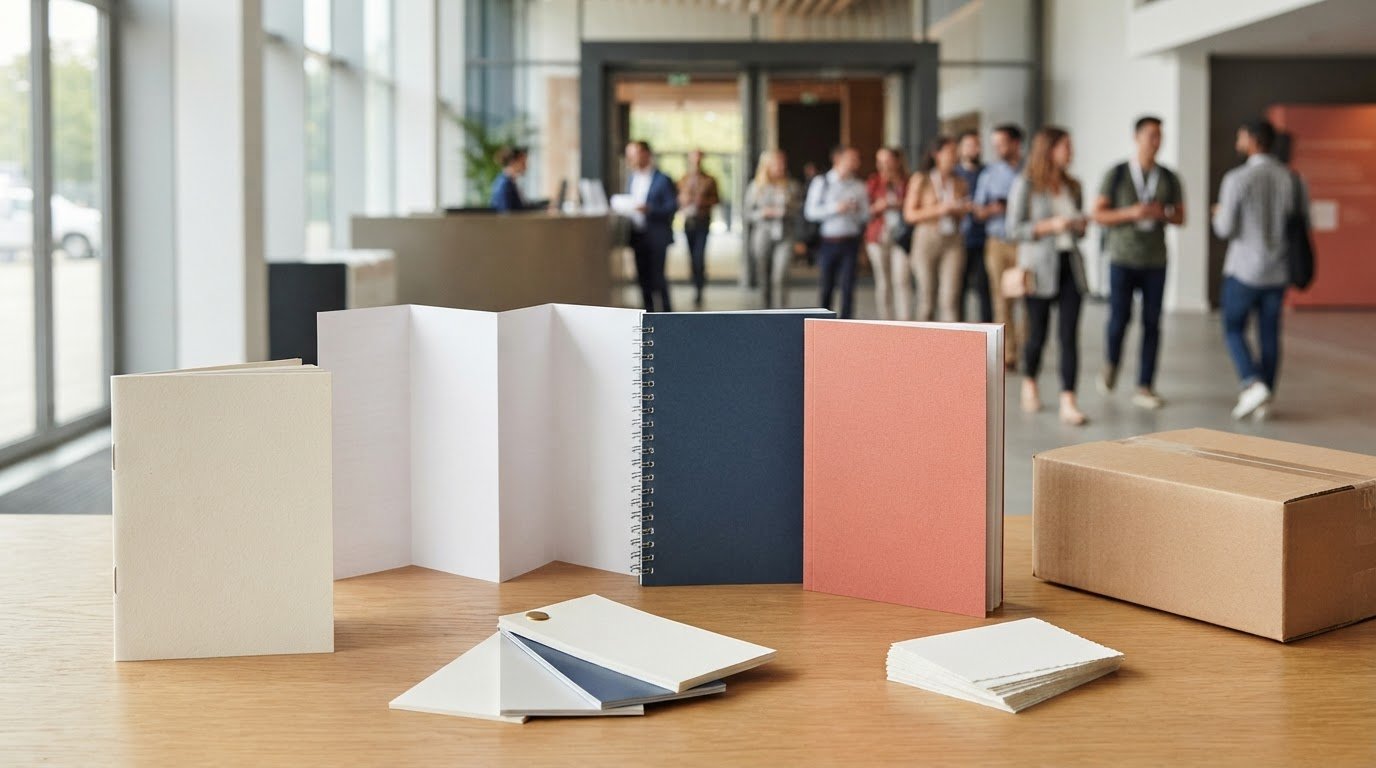
The simplest-looking format may not be the most economical once paper, finishing and collection or delivery are considered. For event programme printing near me, plan around the booklet format, paper, quantity, finishing and how the programmes will reach your venue.
Your programmes need to suit the event, read clearly and be ready on time. The right choices depend on how much information they must include, the impression you want to create and how copies will reach the venue.
This guide explains how format, paper and quantity shape a print order, and compares practical finishing and handoff options. You’ll also learn what to prepare for a quote, so you can make decisions efficiently and keep production aligned with your event schedule.
Key Takeaways
- Plan collection or delivery around your event schedule, venue access and the number of locations receiving programmes.
- Choose a booklet format and paper that suit your content, handling needs and desired presentation.
- Match the print method and quantity to your run size, then prepare print-ready files with the correct dimensions and bleed.
- Compare local collection and delivery options by how they fit your deadline and event logistics.
- Use booklets, brochures or wire binding to create a programme format that supports the information your guests need.
Order pickup, delivery, and shipping
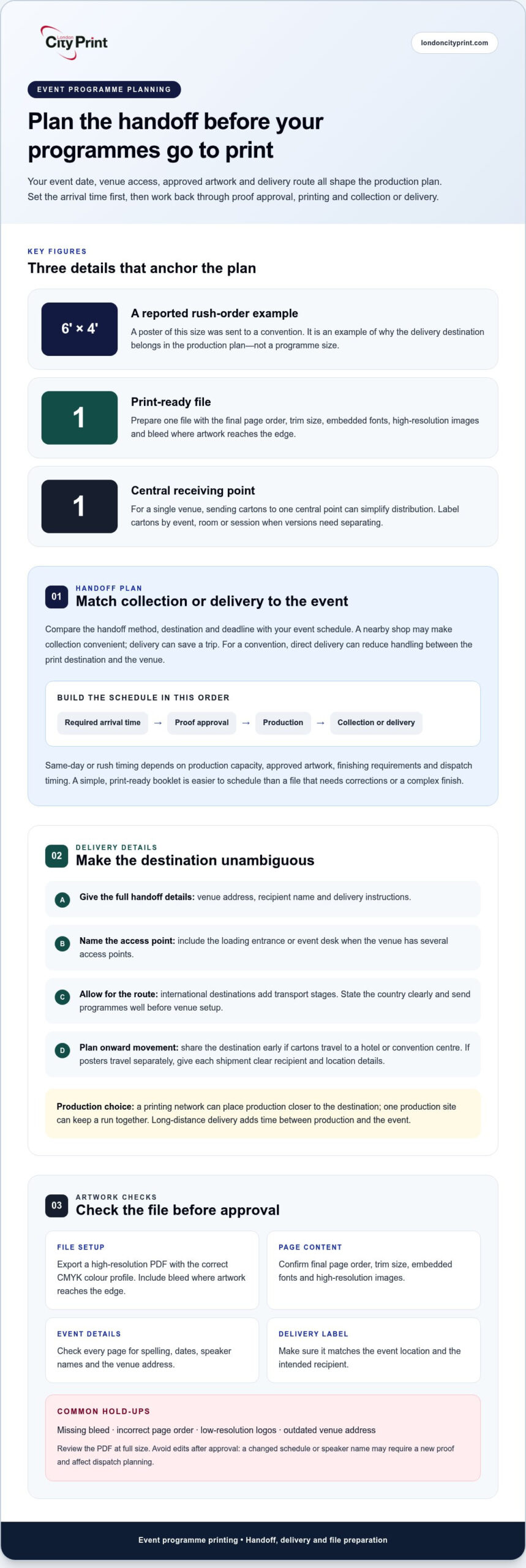
Plan the handoff alongside production, not after the programme files are approved. Your event date, venue access, delivery address and setup schedule determine whether collection or transport fits best. For a convention, direct delivery can reduce handling between the print destination and the event venue. A reported rush order for a 6′ x 4′ feet poster went to a convention, showing why delivery destination belongs in the production plan.
A local print shop and an online printer offer different practical advantages. Collecting from a nearby shop can be convenient, while delivery can save a trip to the print shop. Compare the handoff method, destination and deadline with your event schedule rather than choosing by location alone.
Same-day or rush event programme printing depends on production capacity, approved artwork, finishing requirements and dispatch timing. A simple, print-ready booklet is easier to schedule than a file needing corrections or a complex finish. Set your required arrival time first, then align proof approval, production and collection or delivery around it.
For delivery, provide the complete venue address, recipient name and instructions. Include a loading entrance or event desk if the venue has several access points. For an international destination, allow for additional transport stages and state the country clearly. Send programmes for an overseas conference to the venue well before setup, rather than treating them like a routine office delivery.
Long-distance delivery adds time between production and the event. Share the destination early, especially if programmes must travel onward to a hotel or convention centre. Sending cartons to one central receiving point can simplify distribution at a single venue. Label cartons by event, room or session when staff need to separate versions quickly.
A printing network can place production closer to a delivery destination, while one production site can keep a run together. These approaches affect transport distance and how versions move through fulfilment. If your event also needs posters, consider whether those items should travel with the programmes or arrive separately. Separate deliveries can suit different setup times, but require clear recipient and location details for each shipment.
Prepare one print-ready file with the final page order, trim size, embedded fonts and high-resolution images. Export a high-resolution PDF, use the correct CMYK colour profile and include bleed where artwork reaches the edge. Name the file clearly, such as “conference-programme-final,” and identify the version approved for printing.
Common mistakes include missing bleed, incorrect page order, low-resolution logos and an outdated venue address. Review the PDF at full size, check every page and confirm the delivery label matches the event location. Avoid edits after approval: a changed schedule or speaker name may require a new proof and affect dispatch planning.
Booklet printing and paper options
Choose a booklet format by starting with its purpose at the event. A concise running order needs less space than a programme with speaker biographies, venue maps and sponsor graphics. List the content first, then group related information into sections. This gives the designer a clear page plan and helps readers find schedules, names and practical details quickly.
Brochures and booklets serve related but different purposes. A folded brochure can present a short schedule or event overview in a compact format. A multi-page booklet suits detailed programmes, with separate pages for sessions, contributors and acknowledgements. For example, a conference can put its timetable near the front and reserve later pages for speaker profiles.
Booklets and catalogues also differ in how readers use them. A catalogue usually organizes products or entries for browsing, while an event programme guides people through a specific occasion. If your programme includes exhibitors, sponsors or session listings, use clear headings and a consistent grid. Keep essential details easy to find, even when graphics fill several pages.
Paper affects appearance, handling and readability. Lighter text stock can make a multi-page booklet easier to carry, while heavier cover stock can distinguish the cover from the inside pages. The right combination depends on page count, use and desired finish. Review a digital sample or physical proof before approving a large run.
Consider how colour and images will reproduce. Prepare photographs and graphics at a suitable resolution, and keep text contrast strong enough for the venue lighting. CMYK files support standard print colour, but colours may look different from a screen. Check logos, sponsor names and event dates carefully. A printed business card beside the programme can help you compare brand colours.
Binding should match how guests handle the programme. A folded format works for a brief schedule, while a bound booklet keeps longer content in sequence. For a sports event using jersey colours in its identity, repeat those colours consistently across headings and section markers. Avoid placing small text over detailed graphics, where legibility can suffer.
Production method and quantity affect turnaround planning. Digital printing can be a practical option for smaller runs. Estimate attendance, speakers, staff and spare copies before setting the quantity. A stable page count and approved artwork help production proceed smoothly. If your programme combines schedules with sponsor information, finalize those sections together to avoid late changes across multiple pages.
Before approval, review the cover, page order, spelling, dates and contact details. Ask someone unfamiliar with the layout to find the venue map or first session. This simple test can reveal confusing navigation. Once the content is final, choose a format and paper stock that suit your event identity and the way guests will use the programme.
Printing for small and large runs
Plan the quantity around attendance, staff, speakers and distribution points. Count copies for registration desks and reserved seating separately rather than relying on an arbitrary surplus. For example, a conference with several entrances may need programmes allocated across each reception point.
Digital printing suits short runs, defined guest lists and programmes likely to need updates. It can produce copies from one approved file. Finalize names and schedules before releasing the order. For event programme printing near me, include the quantity and required completion date when comparing production options.
For larger runs, assess production methods against quantity, page count, paper and finishing. Confirm the full specification before production starts. If you expect repeat orders for a campaign, retain approved artwork and version details. This gives future orders a clear reference without assuming event content will stay unchanged.
Attendance estimates can change, so plan distribution carefully. A formal dinner may need a programme at each place setting, while an exhibition may use shared stacks near the entrance. Count planned placements first, then add copies for staff and speakers who need them.
A reported order for 150 funeral programs was completed in time for the family. This example shows why a defined quantity matters for a time-sensitive event. Set your own estimate using the latest attendance information and account for reserved copies before submitting the order.
Create separate versions only when the content differs. A multi-session conference could use one main programme and distinct inserts for individual workshops. Label each file by event, language or session, and clearly identify the approved version. This helps prevent teams from distributing the wrong schedule.
Artwork approval also affects production planning. A speaker-name edit can require changes throughout the run. Assign one person to collect corrections and review dates, session titles, sponsor acknowledgements and page order together. Release the final file only when that review is complete.
Use this sequence to prepare your order:
- Estimate copies from attendance, distribution points and staff needs.
- Group shared content and identify separate versions.
- Collect corrections through one designated reviewer.
- Approve the final file before production begins.
These steps give your team a clear quantity plan for event programme printing near me and help align the order with actual use.
Local print shop location
When looking for event programme printing near me, compare the print shop’s location with your venue and collection route. Collection can be practical when the shop is nearby, while delivery may suit a venue where staff have little time for errands. Map the print shop, event entrance and preferred collection window before choosing a handoff plan.
A print facility near the British Museum in Central London gives local planners a clear geographic reference. If your event takes place elsewhere, assess the distance between production and venue instead. A nearby address matters most when you can collect finished programmes without disrupting setup, rehearsals or guest registration.
Use these steps to assess location fit:
- Map the print facility against your venue and accommodation.
- Identify the entrance or reception point for collection.
- Set a collection window that leaves time for setup.
- Choose delivery when carrying cartons would complicate event preparation.
Local access can be useful for a late artwork handoff, but location alone doesn’t determine turnaround. File readiness, page count, finishing and production capacity also affect timing. If you need the programmes for an evening event, plan backward from the time staff must place them at registration.
Compare digital and offset printing as production methods, not as promises tied to a shop’s address. Digital printing suits short runs under 500 units. For larger requirements, the print method, quantity and specification shape the production plan. Ask for the method that matches your run and schedule, then align collection or delivery with completion.
Think beyond a single venue. A conference across several locations may need separate programme batches for each site. Label cartons with the venue name, room or event date, and keep a dispatch list for each destination. A morning seminar and an evening reception, for example, may need different schedules and delivery points.
Local searches can help you assess practical access. Check the street address, public transport options and vehicle approach on a map. A venue near a pedestrian-only street may make carton collection harder than a location with a loading area. Plan the route around event equipment and how much your team can carry.
Keep the collection plan simple. Assign one staff member to receive the order, check the carton labels and move programmes to the correct room. If signage is also required, decide how it will travel with the booklets. Window displays and other event materials may need a separate placement plan from guest programmes.
Choose a location and handoff that protect your setup schedule. Collecting from a nearby print shop can work well; delivery can reduce travel between production and the venue. Match the option to your route, event locations and available staff, then include those details in the order plan.
Paper stock options
For event programme paper sizes, stocks and finishes, start with the page content and how guests will handle each copy. Choose a format that fits schedules, maps and speaker details, then select paper and finish to suit readability, appearance and distribution.
Paper weight affects how a programme feels and handles. Lighter text stock can help keep a multi-page programme easy to carry; a heavier cover can distinguish it from the inside pages. For a compact dinner programme, prioritize comfortable handling. For a detailed conference guide, balance page count with portability.
The paper surface matters too. Coated stock can give photographs and colour graphics a smoother appearance, while uncoated stock can make written notes easier. Match the finish to the content: a sponsor-heavy event may prioritize image reproduction, while a workshop schedule may need practical writing space.
Choose the finished size before layout begins. A narrow format can suit a short running order, while a larger page gives maps and multiple session tracks more room. Check how the folded or bound programme will sit in a guest’s hand, and keep essential details clear of trim edges.
Finishes affect both appearance and usability. A gloss finish can make colour images appear more pronounced, but may create reflections under bright venue lighting. A matte surface can reduce glare and support comfortable reading. For an evening event with low lighting, test small text and contrast before approving production.
Consider how the programme will be distributed. Direct mail means extra handling, so suitable packaging and a cover matter. At trade show displays, guests may pick up copies repeatedly; a more substantial cover can help the programme retain its shape. Coordinate banners and printed materials through consistent colours and typography.
Use this simple selection sequence:
- List the content, including maps, schedules and sponsor graphics.
- Choose a page size that gives each element enough space.
- Match text and cover stocks to handling and presentation needs.
- Review colour, contrast and small type under realistic lighting.
Request a proof if paper feel or colour reproduction will affect your decision. Review the cover and inside pages separately, then check that images, fine text and page edges reproduce as intended. This can catch issues that are difficult to judge on screen.
For a coordinated event setup, pair your printed programme with roller banners for event displays. Keep the shared colour palette and key event details consistent across both formats.
London City Print: Booklets and Brochures
London City Print produces Booklets and Brochures for event programmes that need clear structure and professional presentation. Choose a booklet for schedules, speaker details and venue information, or a brochure for a concise event overview. Wire binding suits programmes that need to open flat for easy reference during sessions.
You can coordinate supporting print materials, such as Posters or Pull-Up Banners, with your programme’s visual identity. Prepare the final content, page order and print-ready artwork before requesting production. London City Print’s in-house Graphic Design team can create artwork from scratch or fix files that are not print-ready.
If your programme format and artwork are ready, contact London City Print to discuss your Booklets and Brochures requirements.
Put your event plan into print
Your programme is part of the event experience, not just a schedule. Give it a clear role in welcoming guests, guiding them through the day and reflecting the event’s identity. Before production, decide who owns final approval and keep that person’s contact details and the latest content together. A focused approval process helps your team move from planning to print with fewer crossed wires.
Finding event programme printing near me is the start of the decision. London City Print offers Booklets and Brochures for your programme, Posters for event information and Wire Binding for booklets that need to open flat. Choose the format that fits how attendees will use the printed materials, then share your requirements with the print team.
Contact London City Print to discuss your order and take the next step towards a programme that supports your event. With a clear plan and the right format, you can move forward with confidence.
Frequently Asked Questions
How much will my order cost?
Production requirements depend on quantity, page count, finished size, paper, binding and delivery plan. A short programme with one shared version needs a different setup from a multi-section booklet with separate inserts. Prepare these details together, including finishing requirements, so the job can be specified accurately before production planning begins.
What are the most common paper options?
Common programme papers include coated and uncoated stock, with cover stock selected separately when the design calls for it. Consider how the programme will be used: a schedule that guests will annotate benefits from a writable surface, while image-led pages need clear colour reproduction. Review a sample if feel, opacity or colour appearance will influence your selection.
What are local event program printing prices and turnaround times?
Production timing depends on the approved file, quantity, page count, binding and finishing requirements. A completed, print-ready design can move into production planning more directly than artwork that still needs edits. Share the event date and when the programmes must be ready for distribution, then provide the final specification to help coordinate the schedule.
What are the minimum order quantities for printed event programs?
The practical minimum depends on the format, production setup and finishing. Start by counting individual copies needed for guests, speakers and staff, then consider whether shared copies at information points suit your event. A seated ceremony may need copies assigned to places, while a drop-in event may distribute them from a welcome desk.
Should I choose local pickup or delivery for event program printing?
Choose collection if a team member can pick up and transport the finished programmes as part of their event duties. Delivery can be more practical when staff need to stay onsite or cartons must go directly to a receiving desk. Decide who will accept the order, where it should be left and how the team will move it to the distribution area.
How do quantity and page count affect event program printing costs?
Quantity and page count shape production because they determine how many copies and how much printed material the job requires. A short running order differs from a multi-track conference guide with speaker profiles and venue information. Settle the content, page sequence and number of versions before production planning, especially when each event location needs a different schedule.