Could a larger board make your message harder to read? The right choice depends on where people will see it, how far away they’ll stand and what your artwork needs to communicate. With foam board printing london, planning the display and file together helps you avoid an awkward fit, unreadable detail or a last-minute artwork correction.
You may already know how much space your display needs to fill, but choosing dimensions is only part of the brief. This guide explains how to select a format for your venue and viewing distance, prepare artwork at the correct scale, and provide clear print details. You’ll also learn what to specify about the intended use, so the board suits the setting.
Before production, prepare a high-resolution PDF at the agreed final size. Include bleed where the design runs to the edge, and check that text and images remain clear at the intended viewing distance. We’ll cover the details to include in your London print brief, from finished dimensions and artwork to your deadline, so you can plan your display with confidence.
Key Takeaways
- Match your board format to the available display space, viewing distance and amount of information you need to present.
- For foam board printing london, include the intended setting and finished dimensions in your brief so the project starts with clear requirements.
- Set out your requirements for material thickness, finish and mounting, and make sure they match the product specification.
- Before exporting your high-resolution PDF, check the final size and layout. Add bleed and crop marks when your design extends to the trimmed edge.
- Give London City Print your quantity, artwork and display context to help organise your print project efficiently.
Foam board printing in London: when does a display board make sense?
Foam board printing creates a printed display on a firm board surface. It gives you a way to present a message, image or information in a physical space, such as a presentation panel, exhibition display, reception sign or workplace notice. For a general overview of the material and its common uses, see What is foam board?
The right format depends on what the board needs to do. At an exhibition, a clear headline and strong image can catch the attention of people passing by. In a meeting room, your audience may stand close enough to read supporting details. A reception display may need to communicate a concise welcome or key information as visitors enter.
Plan around the location and audience, not just the artwork. Consider how far people will stand from the display, what else competes for their attention and how long they have to read it. Use these factors to set the information hierarchy: make the main message easy to spot, then size supporting text for the expected viewing distance. Keep essential content legible instead of filling every available area.
What is foam board printing used for?
Use a printed board when you need a physical display for a defined space. For a business presentation, it could organise a project overview into a clear visual aid. At an event, it could carry a welcome message or direct attention to key information. In a workplace, it could communicate an internal update in a shared area. Match the design and scale to the audience, purpose and placement.
Before choosing a format, check the display area and how people will encounter it. A board near an entrance may need a simple message that reads quickly. A board viewed at close range can carry more supporting detail. If you have several messages, group them clearly and give the most important information visual priority. This helps your artwork work at its intended scale.
Is foam board right for your display?
Choose a firm display surface when the brief calls for a board that holds its shape in a presentation or display setting. A flexible poster or roller banner may fit better if you need a format that rolls or folds for transport. Base your choice on the venue, viewing distance, display duration and how often you’ll handle or move it.
Think through practical details before settling on the artwork. Will the display stay in one place, or travel between venues? Will people view it from across a room or close up? Does the space have a wall, stand or other planned display position? If the board will be used outdoors, state that clearly in your brief so the print plan reflects its intended setting.
There’s no single size that works for every presentation or event. Foam board printing london should start with the display context, audience and message, then move to dimensions and artwork. A clear brief gives you a sound basis for choosing the format and preparing a design that fits its space.
How to choose foam board size and format for your display
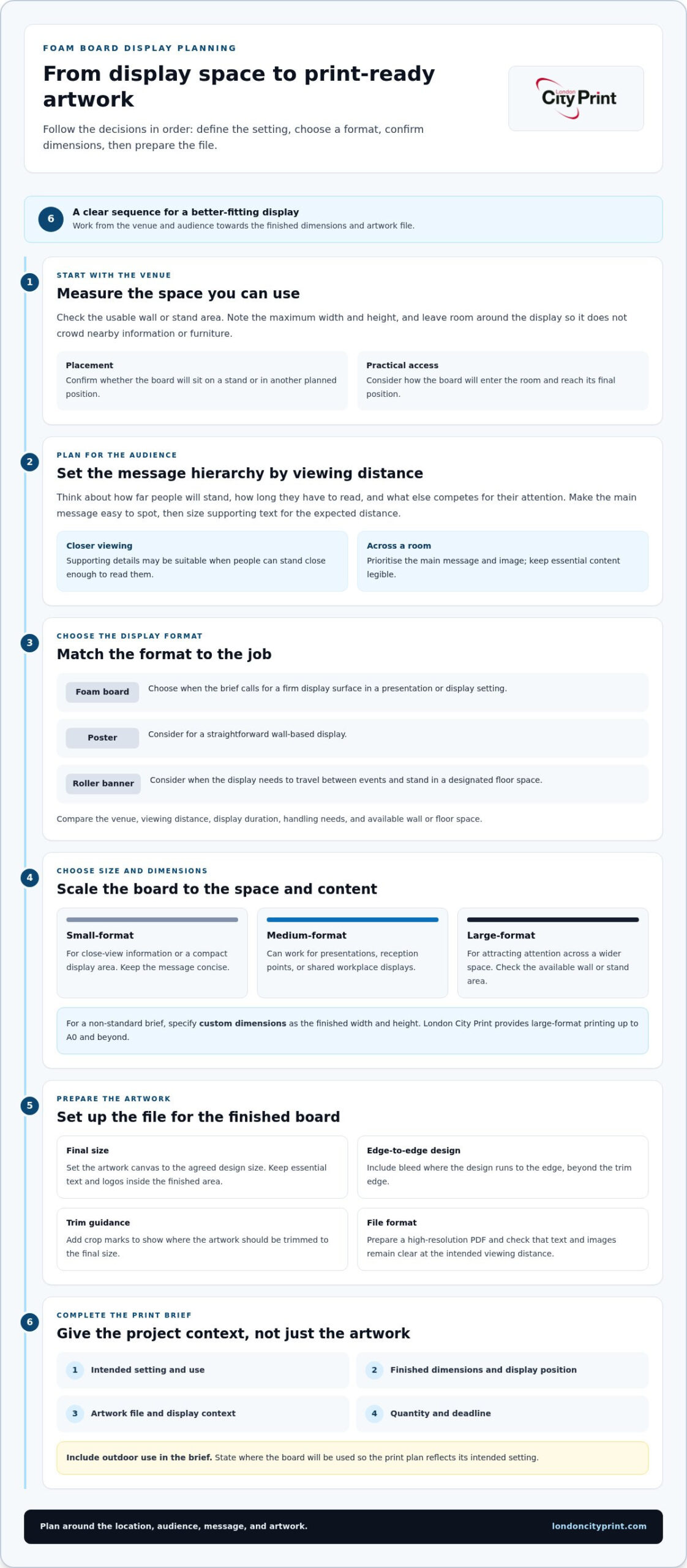
Start with the space, not a standard paper size. Measure the usable wall or stand area, then allow room around the display so it doesn’t crowd nearby information or furniture. Next, consider how far away your audience will stand and how much content they need to read. A longer message may need more space, but clear hierarchy matters more than filling every part of the board.
Use these broad format categories to guide your planning:
- Small-format: Suits close-view information or a compact display area. Keep the message concise and check that text remains readable at the intended distance.
- Medium-format: Can work for presentations, reception points or shared workplace displays. Balance a clear headline with supporting text and imagery.
- Large-format: Fits displays intended to attract attention across a wider space. Prioritise the main message and image, and confirm the available wall or stand area.
How do you select dimensions for a presentation board?
Measure the display area and note the maximum width and height you can use. Allow for placement or mounting, and consider how the board will enter the room and reach its final position. For a non-standard brief, specify custom dimensions as the finished width and height rather than relying on a visual estimate.
Set the artwork dimensions separately from the finished board dimensions. The artwork canvas should match the agreed design size and include any required bleed beyond the trim edge. Crop marks show where to trim the artwork. Keep essential text and logos inside the finished area so trimming doesn’t remove important details. London City Print provides large-format printing up to A0 and beyond. Give us the dimensions required for your foam board project so the brief is specific to the display.
Foam board, poster or roller banner: which format fits?
Choose based on how the display will work in the venue. Foam board suits a brief that calls for a firm display surface. A poster can be a straightforward option for a wall-based display, while a roller banner may suit a message that needs to travel between events and stand in a designated floor space. Consider how long you’ll use the display, how often you’ll move it, and whether you have wall or floor space.
When comparing formats, assess the intended position, audience distance and handling needs together. London City Print’s large-format printing services support display planning across formats. For broader context on workplace safety in print production, OSHA provides a printing-industry safety resource. A clear brief for foam board printing london should name your finished dimensions, location and intended use, so the format and artwork fit the job.
What should you compare before ordering foam board printing?
Start your comparison with the job the display needs to do. Bring together its intended setting, finished dimensions, artwork requirements and handling needs. This helps you set priorities and compare product details against the needs of your project.
Use these points to organise your brief:
- Setting: State whether the display is for an indoor event, presentation, reception area or another environment.
- Placement: Note whether you plan to wall-mount the board, place it on a stand or move it between locations.
- Dimensions: Give the required finished width and height, and state whether the design needs a non-standard size.
- Artwork: Describe the content and whether people will read it from close range or at a distance.
- Handling: Explain how often the display will be moved, packed or repositioned.
These details help you weigh appearance, portability and the demands of the display environment. A board that stays in one presentation space has different handling needs from one that travels between event locations. Likewise, a layout with a short headline and image has different artwork demands from one carrying detailed information. Decide what matters most before production.
Which display requirements should shape your choice?
Think about how the board will be supported and used. A wall-mounted display needs a suitable placement plan; a board on a stand needs dimensions that work with that stand. If people will handle it frequently, include that in the project brief. Keep the content appropriate to the audience’s viewing distance, with the headline and essential information easy to identify.
What should you check about materials and finishing?
Compare the product details that affect your display, including material thickness, finish and mounting details. Make sure your expectations about the surface, edges or mounting match the selected specification. If you have a particular requirement, state it clearly in the brief before finalising the artwork.
A finish can affect how a printed surface looks, and lighting can change how sheen or glare appears. Consider the display lighting when choosing a finish. Include any mounting, edge or shape requirements in your brief so they’re considered alongside the artwork and display plan.
Eco-conscious stocks and FSC-certified paper are relevant to suitable paper-based print projects, but they don’t describe the composition or certification of foam board. Keep material requirements specific to the product you’re briefing. For foam board printing london, a concise specification helps align the display setting, artwork and product details from the start.
How to prepare artwork for foam board printing
Accurate artwork setup helps your display print at the intended size and keeps important content clear. Before you send a file for foam board printing london, check the finished dimensions, layout and export settings in order. Don’t rely on a screen preview alone. A file that looks correct on screen may still contain scaling, colour or resolution issues that affect the printed result.
- Confirm the finished dimensions. Set the artwork to the agreed final width and height. Keep the board’s finished size distinct from any extra area required for trimming.
- Check the layout. Review the headline, body text, logos and images at the intended display size. Keep essential content clear of trim edges and cutting areas.
- Export high-resolution PDFs. Check that images have enough resolution for the final dimensions, embed the fonts and use a colour profile suitable for print.
Which file format and layout details matter?
A high-resolution PDF preserves layout, fonts and image quality in a print-ready file. Before exporting, confirm the page size matches the agreed finished dimensions and make sure your design software hasn’t scaled the page unexpectedly. The fit to page setting can shrink artwork to fit a printable area, creating a scale error. Check the PDF’s page dimensions after export, not just the original design document.
Inspect small text, logos and image detail at the actual output scale. Avoid placing essential text or graphics close to the edge, where trimming could affect them. Your pre‑flight file checks should cover dimensions, image resolution, embedded fonts, colour profile and bleed. A file‑checking service can review those details before production, but you still need to supply the correct finished size and artwork.
How do bleed, crop marks and colour affect the result?
If your background colour or image runs to the board’s edge, extend it beyond the finished trim line. Printers call this extra area bleed. It gives the trim area coverage and helps avoid a thin unprinted border if the cut shifts slightly. Keep text and other important elements inside the finished area.
Crop marks show where the printer should trim the sheet. Include them when your print setup calls for them, and place them outside the finished design so they don’t cross important content.
Prepare colour in CMYK where appropriate for the print workflow. CMYK uses cyan, magenta, yellow and black inks, while screens display colour using light. As a result, some colours may look different in print than they do on your monitor. Review the final PDF before sending it, especially if colour accuracy matters to your design.
Prepare your artwork and finished dimensions together, then submit your foam board printing brief with the details needed to progress the project.
Foam board printing in London: briefing London City Print
A useful print brief gives the production team the information needed to understand your display and prepare the project accurately. For foam board printing london, explain the setting and purpose alongside the artwork. A board for a reception area may need a different layout from a display for a presentation or event, even when the finished dimensions are similar.
What information should you include in your print brief?
Bring the main project details together before sending your request. Include the finished dimensions, quantity, intended setting and required deadline. Attach the final artwork, and state any trim, mounting or custom-dimension requirements that affect production. If you prefer eco-conscious stocks, mention this for suitable paper-based print projects. It doesn’t describe the foam board itself.
- Finished size: Give the final width and height, and distinguish them from the artwork canvas or bleed area.
- Quantity: State how many boards you need and whether the artwork is the same for each one.
- Display context: Explain where the board will be used, how it will be positioned and who will view it.
- Artwork: Attach the final print file and flag any requirements for trimming, mounting or shape.
- Deadline: Give the date and time you need the finished project, so the schedule is clear from the outset.
Be specific about anything that could affect the finished result. If the board needs to fit a defined display space, provide the usable area and explain how you intend to place it. If your file includes a design that runs to the edge, note the trim setup. Clear details reduce avoidable back-and-forth and help keep your project moving.
How does London City Print support a professional print project?
London City Print has served print customers since its founding in 2009. Its Central London facility is near the British Museum, and the company provides foam board printing alongside broader commercial and large-format print work. Large-format printing is available up to A0 and beyond. Include the dimensions required for your foam board project in the brief.
A well-organised request brings your artwork, dimensions and display requirements together at the start. Include the deadline, final file and any project-specific notes. London City Print can then use those details to understand the job and its intended use without relying on assumptions about your venue or display setup.
To move your project forward, discuss your foam board printing project with London City Print and share your dimensions, artwork, quantity and deadline.
Move your display project forward
Turn your display idea into a production-ready request by aligning the people responsible for the venue, design and print before you send the final brief. That way, everyone works from the same finished dimensions, approved artwork and deadline, reducing the risk of late changes disrupting your plans.
For foam board printing london, clarity at the start supports a smoother handover from concept to print. Confirm who will approve the file, check that the display location can accommodate the finished board, and keep your project notes with the artwork. If your plans change, update the brief and file together so the production details stay consistent.
You don’t need to settle every design decision alone. Share the purpose of the display and the requirements you’ve defined, then take the next step with a clear project request. A well-prepared brief gives your print project a confident start and lets you focus on the event or presentation ahead.
Plan your foam board display project with London City Print, and move forward with a clear brief.
Frequently Asked Questions
Is foam board suitable for an exhibition display?
Yes, foam board can suit an exhibition display when you need a printed board for a presentation area. Plan how it will reach the venue and where it will sit once there. For a display with a short viewing time, give the headline and key image priority over supporting detail. Include the event context and display method in your brief so the print plan reflects how visitors will encounter it.
Can you print custom dimensions on foam board in London?
You can specify custom dimensions in your brief when your design needs a non-standard finished size. State the width and height, then describe the available display space and how the board should fit it. London City Print provides large-format printing, so give us the dimensions for your foam board project rather than assuming a general format range applies to every board. This gives the project a clear basis for planning.
How do I prepare a file for foam board printing?
Set the document to the agreed output size, then export a high-resolution PDF with fonts embedded. Check that images remain clear at the intended display scale, especially logos and small labels. For foam board printing london, name the file clearly and remove unused draft pages or alternate designs before sending it. A clean, final file helps prevent confusion about which version should proceed to production.
Can a foam board design include bleed and crop marks?
Yes, include bleed when a background or image must continue to the trimmed edge. It extends the artwork beyond the final cut, while crop marks identify where trimming should happen. Keep essential copy and logos inside the finished design area. For example, don’t place a sponsor name directly against the edge. Follow the agreed file setup so marks remain outside the printed design and don’t compete with its content.
What details should I provide when requesting foam board printing?
Give the print team the finished size, quantity, intended display setting, deadline and final artwork. Add practical notes that could affect the job, such as whether boards need to match across several locations or whether you’re supplying multiple versions. Identify any specific requirements for mounting or appearance in plain language. A complete brief helps distinguish essential production details from optional design preferences.
Can foam board printing be used for a business presentation?
Yes, a printed board can support a business presentation by giving attendees a shared visual reference. It can carry a process diagram, product image or project summary while you speak. Keep the board focused on one main idea, and use supporting text only where it helps explain that idea. Before printing, check that the content fits the presentation agenda and matches the version you plan to discuss.