What looks perfect on screen can feel different in print. Choosing party invitation printing services involves more than approving a design: the paper, finished size and surface all affect the result, while colour settings and artwork preparation influence how accurately it reproduces.
To get invitations that suit the occasion and reach guests in time, decide on the essentials early. Set your quantity, dimensions and paper requirements, then check the artwork before approving production. This guide explains how to compare specifications, prepare a print-ready file and plan the steps from design approval to finished invitations.
You’ll also learn why screen colours can vary in print, how CMYK colour and bleed support production, and what information to include in your brief. Whether you’re planning a celebration or drawing on wedding stationery experience for a special event, clear decisions make it easier to get the result you want.
Key Takeaways
- Define the event, audience and invitation’s practical purpose before settling on a design.
- Compare dimensions, paper weight in gsm and finish against your layout and mailing plans.
- When comparing party invitation printing services, consider digital printing for short runs under 500 units.
- Prepare artwork by checking its dimensions, image resolution, colour mode and bleed before approval.
- Plan around your event date and quantity, allowing time to proofread and approve the final artwork before production.
Party Invitation Printing Services: Start With the Event and Its Purpose
An invitation sets expectations before guests arrive. Its wording and design can signal whether an event is formal, relaxed, family-focused or businesslike, while the practical details tell guests where to go and how to respond. Before choosing paper or layout, define the occasion, who you’re inviting and how recipients will use the invitation.
Use that brief to guide your print decisions. A formal celebration may call for restrained typography and a clear information hierarchy; a lively family gathering may suit more expressive artwork. In either case, make essential details easy to find. The history of printing offers context on how printed communication has developed, but your event and audience should determine the choices for this job.
What information should a party invitation include?
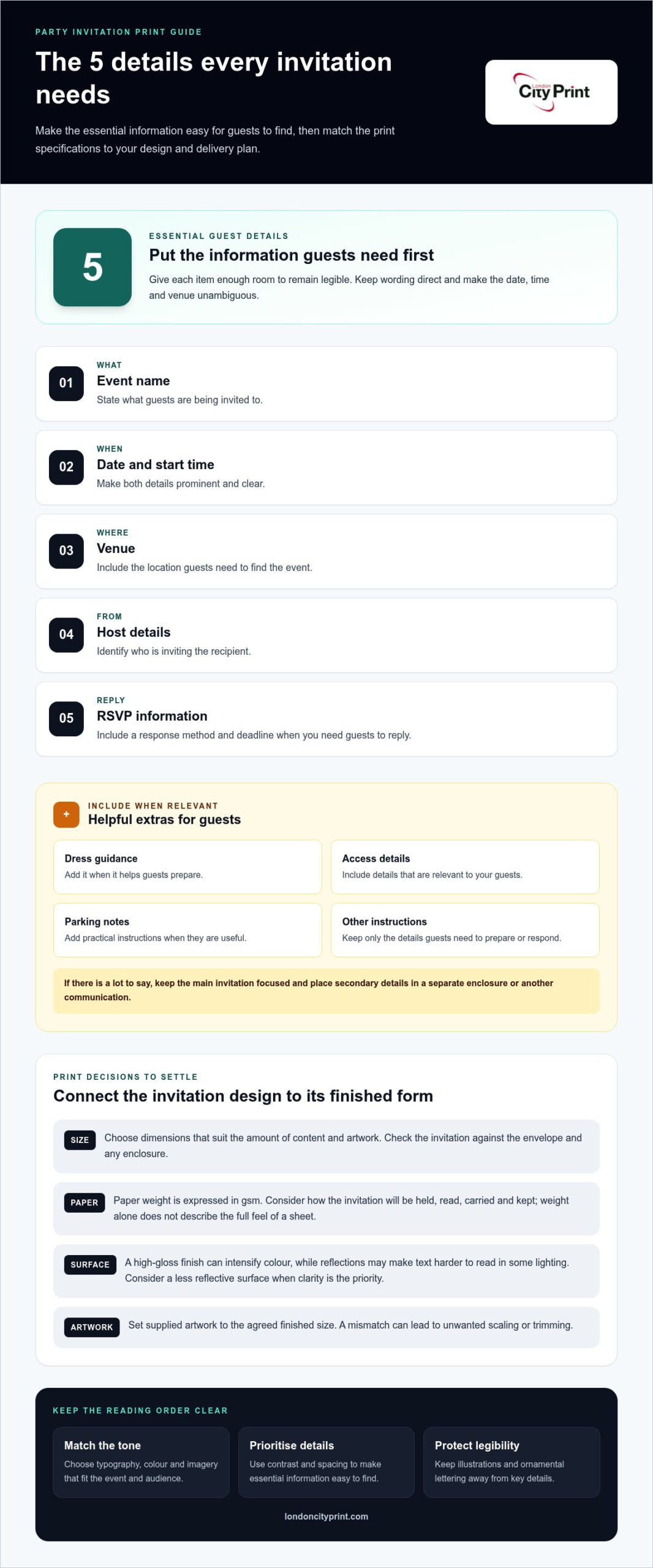
Start with the details guests need to attend. Keep the wording direct and give each item enough space to remain legible. Include extra instructions only when they help guests prepare or respond.
- Event name: State what guests are being invited to.
- Date and start time: Make both details prominent and unambiguous.
- Venue: Include the location guests need to find the event.
- Host details: Identify the host or hosts so recipients know who is inviting them.
- RSVP information: Give a response method and deadline when you need guests to reply.
Add dress guidance, access details, parking notes or other instructions when they’re relevant to your guests. Avoid squeezing in information just to fill space. If you have a lot to say, keep the main invitation focused and put secondary details in a separate enclosure or another communication.
How should the event shape the invitation design?
Match typography, colour and imagery to the event’s tone, then check that the style supports the message. A formal dinner and a child’s birthday party have different audiences and expectations. Choose visual elements that help recipients recognise the occasion without competing with the event details.
Consider how guests will receive and handle the invitation. A mailed invitation needs a layout that remains clear at its finished size and fits your envelope. An invitation handed out in person may be read in a different setting. If guests may keep it as a reminder, make the date and venue easy to find at a glance.
Separate essential information from decoration before approving the design. Use contrast and spacing to establish a clear reading order, and keep illustrations or ornamental lettering away from key details. Your event brief should determine the invitation’s content, visual tone and print choices. Clear priorities help party invitation printing services produce a piece that is both fitting and useful.
Invitation Print Specifications: Choose Size, Paper and Finish Carefully
Once you know the event’s purpose, turn your design decisions into clear print specifications. Dimensions determine the space available for text and artwork. Paper weight and surface affect how the invitation feels and how its design reads. Consider these details together, before finalising a layout that may need to change to suit its printed size.
How do you choose invitation size and layout?
Start with the amount of content and the proportions of the artwork. A long message or prominent illustration may need a different layout from an invitation containing only the essential details. If you plan to include an enclosure, consider its size too. Measure the envelope rather than assuming your chosen invitation will fit.
Standard dimensions can simplify planning when they suit the design. Custom dimensions may work better for distinctive artwork or a specific layout, but they also affect envelope selection and mailing plans. Whichever option you choose, set the supplied artwork to the agreed finished size. A mismatch can cause unwanted scaling or trimming.
What should you know about paper weight and finish?
Paper weight is commonly expressed in gsm, or grams per square metre. It helps you compare paper weights, but it doesn’t describe the full feel or suitability of a sheet on its own. Think about how recipients will hold, read, carry and keep the invitation. Choose a specification that works with the design and how you’ll distribute it, rather than relying on a universal weight recommendation.
Surface and finish influence appearance and readability. A high-gloss finish can intensify colour, but reflections may make text harder to read in some lighting. A less reflective surface may suit designs where clear reading is the priority. Align the artwork, paper and finish before production. For broader industry information, the Association for PRINT Technologies provides resources on print industry standards.
Use these comparisons to connect practical needs with specification decisions:
- Text-heavy invitation: Allow enough finished space for clear, readable type.
- Artwork with a distinct proportion: Compare standard dimensions with custom dimensions, then set the artwork to the final size.
- Invitation sent in an envelope: Check the finished dimensions against the envelope and any enclosure.
- Strong colour or detailed imagery: Consider how the paper surface and finish affect colour and reflections.
- Invitation guests may keep: Choose a paper weight and finish with handling in mind.
Before approving your design, record the finished dimensions, paper weight, intended surface or finish, and envelope requirements in one brief. London City Print produces wedding stationery and can print invitations to the agreed specification. Bring your decisions and artwork to London City Print’s invitation printing service for production support.
Digital or Other Print Methods: Compare Options for Your Invitation Run
The right production approach depends on the size and requirements of your invitation job. Digital printing is most efficient for short runs under 500 units, making it a practical option to consider for a smaller guest list. For a larger quantity, compare production options against the full project requirements instead of assuming one method suits every order.
Run size is only one consideration. Think about whether your artwork is ready for print, how consistently the design needs to reproduce across the quantity, and whether details may change before approval. Finalise names and event information before confirming the run. An approved file gives production a clear version to work from.
When does digital printing suit a party invitation run?
Digital printing is most efficient for short runs under 500 units. This can suit a smaller celebration where you need a defined quantity rather than a much larger run. It also gives you a clear basis for coordinating quantity and approved artwork. The best approach still depends on the job: consider run size, specifications and production requirements together.
For quantities beyond a short run, don’t assume digital is the only suitable approach. Compare production methods against the actual quantity, specification and consistency requirements. Avoid choosing by method name alone. Include the quantity, finished dimensions, paper requirements and artwork status in your production brief.
How many printed invitations should you plan for?
Count invitation recipients, not individual guests by default. If a household receives one invitation, use the household as your counting unit. If guests receive separate invitations, count each recipient. This distinction helps prevent an inflated quantity or a shortfall.
Before approving the run, organise your estimate around these points:
- Recipients: Count households or individual invitees, based on how you’ll distribute invitations.
- Special cases: Include recipients who need a separate invitation, even if they belong to the same household.
- Spare copies: Add a small reserve if you may need replacements or want to keep a copy.
- Final check: Recheck the guest list and distribution plan before confirming the quantity.
For example, if several guests share a household and will receive one invitation together, count one copy for that household. Include separate copies for anyone receiving an individual invitation. Your guest list and distribution plan determine the total, not a fixed multiplier.
Bring the quantity and production requirements together before placing an order. Clear information helps party invitation printing services match the production approach to your run, while an approved file supports consistent reproduction of the design you’ve signed off.
Will Printed Invitations Match Your Design? Prepare the Artwork Properly
A design can look clear on screen and still need careful preparation before print. Correct dimensions, image resolution, colour settings and bleed help reproduce your approved layout accurately. Follow a consistent pre-flight sequence, and resolve file issues before production begins.
What should a print-ready invitation PDF contain?
Export your design as a high-resolution PDF. This format can preserve the layout, fonts and image quality needed for print production. Check the document setup as well as its appearance on screen. A polished preview alone doesn’t confirm that the file has the right technical settings.
How do bleed, crop marks and CMYK affect print?
Bleed is the area where background colour or artwork extends beyond the final trim edge. It helps prevent unprinted slivers if the sheet shifts slightly during trimming. Crop marks show where the sheet should be trimmed to reach the finished size. Keep important text and design details clear of the trim guides.
CMYK stands for cyan, magenta, yellow and black. It’s a colour mode used for print, while screens display colour using light. Colours may therefore look different in print than they do on your monitor. Review colour-critical artwork carefully, and don’t treat a screen preview as an exact representation of the printed result.
Use this sequence to check your invitation artwork before submission:
- Confirm the dimensions. Set the PDF page size to the agreed finished invitation size. Don’t rely on an automatic “fit to page” setting, which can change the scale.
- Check image resolution. Review images at their placed size. Low-resolution artwork may look soft or pixelated when printed.
- Review colour mode. Prepare colour artwork in CMYK where required, and remember that screen colour and print colour can differ.
- Set bleed. Extend backgrounds and images that meet the edge beyond the trim line. Keep text and other essential details inside the safe area.
- Inspect crop marks and fonts. Include crop marks when the file setup calls for them, and make sure fonts are embedded so text retains its intended appearance.
- Open the final PDF. Check every page for missing elements, unexpected line breaks or layout changes before approval.
Checking dimensions, resolution, colour, bleed, crop marks and fonts before approval reduces avoidable production errors. These pre-flight file checks give you and your print team a clear basis for producing the approved design. For support preparing artwork for party invitation printing services, send your invitation artwork for print review.
Order Party Invitations With London City Print: From Artwork to Production
A clear order starts with a complete brief and moves through artwork, specification, file preparation and production. Party invitation printing services work best when you provide the details that shape the finished job early, especially your event date, quantity and approved design. Leave time to check the artwork before it goes to production.
What should you prepare before placing an invitation order?
Bring the project information together before production planning begins. A complete brief helps align the design, print specification and quantity, while keeping practical requirements visible.
- Event details: Prepare final wording, the event date and the quantity you need.
- Design direction: Share your artwork or describe the intended look, and provide any required logos or images.
- Print specification: Note your preferred dimensions and paper requirements, based on what suits the design.
- Distribution plan: Identify envelope fit, mailing needs and any other handling requirements.
Review the guest list before settling the quantity. If the wording or design is still changing, make those revisions before approving the final artwork. This keeps your file aligned with the production brief.
How can London City Print support invitation production?
London City Print produces wedding stationery and brings print production experience to invitation projects. Operating since 2009, the company can take your project from brief and artwork preparation through to production. A clear sequence connects the design you approve with the specifications used for the finished print.
- Set the brief. Share the event date, final wording, quantity and intended use.
- Provide artwork or direction. Supply your finished design or explain the look you want to achieve.
- Agree the specification. Confirm dimensions and paper requirements so the artwork matches the planned print.
- Prepare and review the file. Check that the final artwork reflects the approved layout and production details.
- Approve before production. Review the final file and specification carefully before the job proceeds.
Plan backwards from the event date. Allow time to finalise wording, prepare and approve artwork, complete production, and distribute invitations to guests. Changes to the guest list can affect the print run, so settle the recipient count before approval wherever possible. A production schedule depends on having the artwork and quantity ready to proceed.
Prepare your brief and artwork, then discuss your invitation printing project with London City Print. If your event also needs other printed materials, include those requirements in your planning so you can coordinate them with the invitations.
Make Your Invitation the Start of a Well-Planned Event
Your invitation can set the tone for the occasion before guests arrive. Decide what impression you want it to create, then carry that intention into the event itself. A consistent visual direction helps the invitation feel connected to the experience you’re planning.
Choosing party invitation printing services gives you a way to turn that direction into a finished piece guests can receive and keep. Keep your priorities in view from concept to production, and make choices that support the atmosphere you want to create.
When you’re ready to take the next step, discuss your invitation printing project with London City Print. Share your brief and artwork to get your invitation project moving.
Frequently Asked Questions
How long does it take to print party invitations?
Production time depends on the job, so set your event date before arranging the order. Include when you need the invitations in hand, not just when the event takes place. You may need time to address envelopes or distribute invitations in person. Final wording, quantity and artwork status all help define the production schedule.
What paper weight is best for party invitations?
Choose paper based on the experience you want recipients to have, rather than selecting a weight by habit. If you can handle a paper sample before deciding, consider how it feels and whether it suits the tone of your event. Also think about how the invitation will be packed and sent. Your paper choice should work with the design and distribution plan.
Can I print party invitations from a PDF?
Yes. A print-ready PDF is a practical format for an invitation order. Before you send it, proofread every name, date, address and RSVP detail against your final event information. Check punctuation and line breaks too, especially around phone numbers or web addresses. A content review catches mistakes that a technical file check may not identify.
How many invitations should I order for my party?
Use your final distribution list to set the quantity, then check it against the number of envelopes or invitation packs you plan to prepare. If guests will receive different versions, such as separate wording for different parts of the event, count each version separately. Record the totals before approving the order so the quantity matches what you’ll distribute.
What is the difference between CMYK and RGB for invitations?
For a printed invitation, prepare the final file using the colour settings required for print rather than relying only on how colours appear on screen. If a particular colour matters to your design, flag it during artwork review and compare the approved proof with your intended look. This helps you make a considered decision before the full order proceeds.
Do party invitations need bleed and crop marks?
Follow the print specification for your artwork file. The right setup depends on how the design meets its edges and how the file will be trimmed. Keep essential wording and small decorative details well inside the finished boundary. Check that crop marks sit outside the invitation artwork and don’t cross text or design elements. This final review helps prevent avoidable trimming issues.
Can digital printing handle a short invitation run?
Yes, digital printing can suit a short invitation run. Before choosing a production approach, decide whether every copy uses the same artwork or whether you need distinct versions. If the design changes between groups, list the quantity for each version in your brief. Clear version details help the production team prepare the correct files for approval.