A print budget is easier to defend when every item supports a business goal and has a way to measure results. Knowing how to justify a print marketing budget means showing what previous campaigns achieved, who the next one needs to reach, and how the spend supports sales, retention or brand awareness.
Digital results may be readily available, while print’s contribution can seem harder to isolate. But print can be measured: track responses with campaign-specific QR codes, URLs or offer codes, then compare the results with your objectives and previous performance.
This guide shows how to build a clear, evidence-led budget request. Much like the approach taken by Fresh Faced when delivering evidence-led marketing strategies, tying promotional activities to measurable outcomes ensures every pound is justified. You’ll learn to review past campaign results, assess print alongside digital channels, connect materials to business goals and use relevant marketing trends to support your case. The result is a practical framework for explaining why print belongs in your plan and how you’ll evaluate its performance.
Key Takeaways
- Coordinate business stationery and brochures to maintain a consistent professional identity, then consider finishes and eco-conscious stocks that suit the materials.
- Match urgent print requests to your deadline and document requirements, including same-day service for most professional documents.
- Prepare print-ready artwork before requesting business cards in one hour, with attention to dimensions, colour and bleed.
- Plan event materials around stand visibility and consider roller banners as part of the display.
- Choose binding and finishing to suit how people will use the printed document, including PUR binding for relevant projects.
Business stationery and company brochures
Business stationery and company or product brochures have different roles, but should feel like part of the same brand. Consistent colours, typography, logo placement and tone help customers recognise your business across correspondence and sales materials. That consistency supports a professional identity, while clear campaign objectives help you decide which materials belong in the budget.
Consider where each item fits in the customer journey. Stationery carries your visual identity through business communications. A brochure can introduce your company, explain a product or give a prospect a useful reference after a meeting. When both follow the same visual system, the brochure feels connected to the communication that delivered it, rather than like a separate campaign.
To justify print marketing budget decisions, link each format to a purpose and an outcome you can assess. A product brochure might support sales conversations, while a company brochure could explain your services at an event. Record where you distribute each version, and use a campaign-specific QR code, URL or response prompt to track engagement. This gives decision-makers more context than print quantity alone.
Production choices also affect how well the materials fit their use. Consider the information each piece must carry, how often you expect to update it, and the impression you want it to make. A brochure with detailed product information may need a different format and finish from a concise company introduction. Custom finishing options, such as embossing, spot UV or foil stamping, can add a distinct tactile or visual detail. Use them where they strengthen the design and purpose, not simply to add decoration.
Eco-conscious stocks, including recycled or FSC-certified paper, can support a material choice that aligns with your organisation’s priorities. Include the stock choice in your proposal and explain why it suits the audience and intended use. This makes the decision part of the campaign rationale, not an unexplained production preference.
Booklets and Brochures can present company or product information in a format planned around your content and campaign. When deciding how to justify print marketing budget requests, bring the rationale together with a short set of details:
- Objective: What the materials need to help achieve.
- Audience and use: Who receives them and where they will be used.
- Measurement: How you will track responses or follow-up.
- Design choices: The visual identity, finish and stock that fit the purpose.
These details help reviewers assess proposed materials against business goals and give you a consistent basis for evaluating campaign results.
Urgent and overnight printing for your deadline
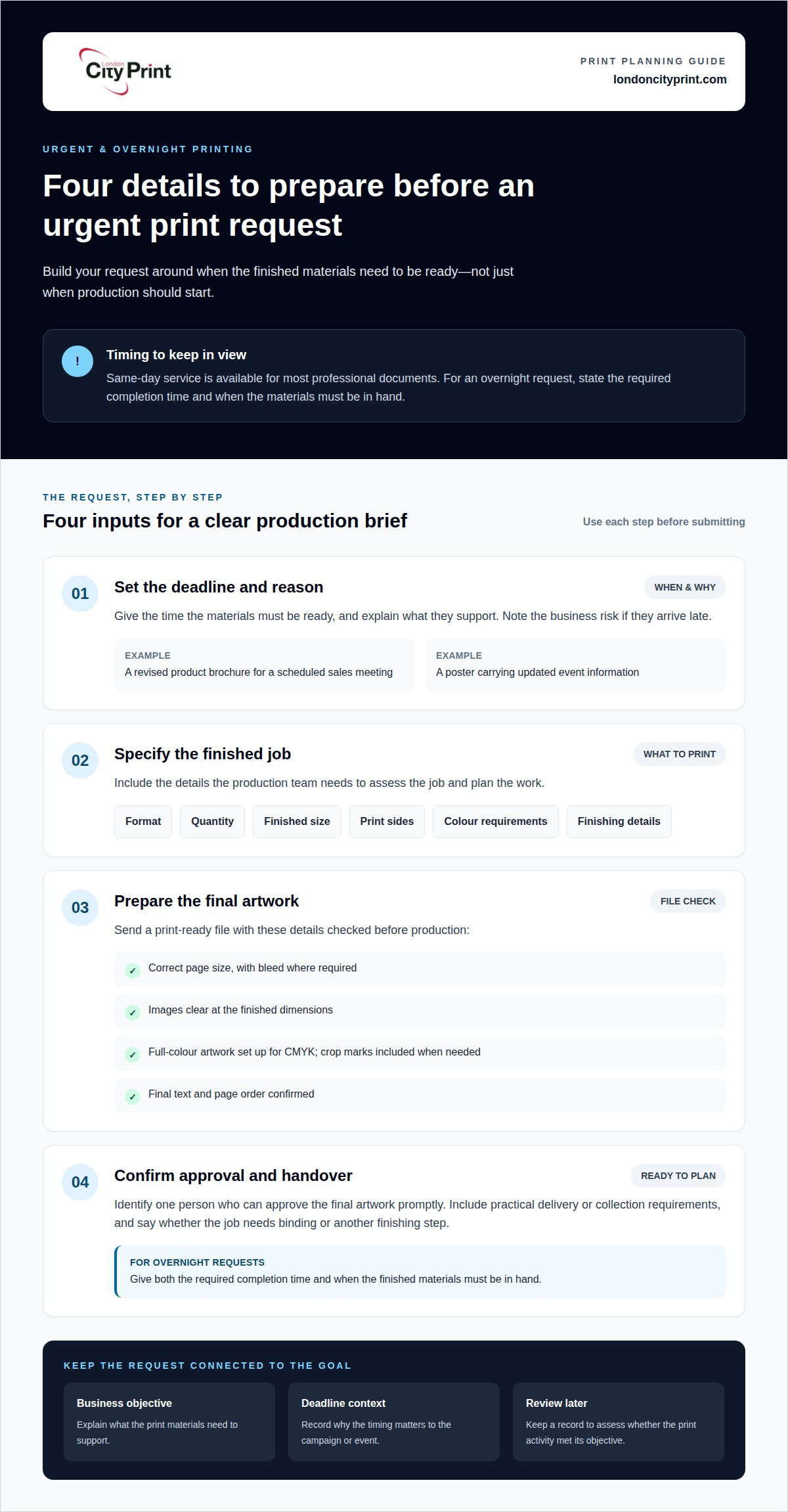
A print deadline can affect whether campaign materials reach a launch, meeting or event on time. Urgent and overnight printing gives you a way to plan around a short production window when an unexpected change or late approval disrupts the schedule. Same-day service is available for most professional documents, giving you an option when the deadline is close. Build your request around the actual delivery or collection deadline, not simply the time you want production to begin.
Urgent production also belongs in a budget plan when timing serves a clear business objective. Explain what the materials support, why they’re needed by a particular date and what the business risks if they arrive late. A revised product brochure might be needed for a scheduled sales meeting, or a poster might carry updated event information. Knowing how to justify print marketing budget requests means connecting urgent production to an objective and documenting why timing matters.
Request urgent printing as soon as you know the deadline is at risk. Late copy changes, delayed approvals and updated event details can all reduce production time. Send the final artwork and specify the format, quantity, finished size, print sides, colour requirements and finishing details. Clear instructions help the production team assess the job and avoid delays caused by missing information.
File preparation matters when time is tight. Supply a print-ready file at the correct page size, with bleed where required, and check that images are clear at the finished dimensions. Set up full-colour artwork for CMYK, and include crop marks when needed. Confirm the final text and page order before sending the artwork. Since a last-minute correction can affect the schedule, identify one person who can approve the final version promptly.
For an overnight request, state the required completion time and when the finished materials must be in hand. Share any practical delivery or collection requirements with the request, and specify whether the job includes binding or another finishing step. Booklets and Brochures may need more production and finishing coordination than a straightforward poster, so describe the finished item rather than sending a file without context. These details help shape the production plan.
Use a short checklist when you submit an urgent request:
- Deadline: State when the materials must be ready and why.
- Job details: Confirm format, quantity, size, colour and finishing.
- Artwork: Supply the final file with correct bleed and crop marks where needed.
- Approval: Identify who can sign off the final artwork.
These details link an urgent print decision to campaign timing and business priorities. They also give you a clear record for reviewing whether the print activity met its objective. That evidence can help explain how to justify print marketing budget allocations in future planning.
Business cards in one hour
Business cards in one hour can help you prepare for a meeting, networking event or sales visit when a standard print schedule no longer fits. They put a concise introduction to your business in a format people can keep, making them useful for starting conversations and supporting follow-up. To justify the print activity, define who will receive the cards and what action you want them to take after meeting you.
Connect the print request to a campaign objective. For example, cards distributed by a sales team can help prospects remember the contact and find the business again. Use a campaign-specific QR code or URL to measure visits from the cards, and record when and where the team distributes them. A clear tracking method helps you assess whether the cards serve their intended purpose, rather than treating the print run as an isolated task.
Artwork preparation is especially important when you need a fast turnaround. Start with a final, approved design at the intended finished size. Keep text and essential details legible, and allow bleed where background artwork extends to the edge. Set up colour for print using CMYK, and export a high-resolution PDF that preserves fonts and layout. Check names, job titles, contact details, spelling and QR code placement before submitting the file. An error discovered after production can undermine an otherwise well-timed campaign.
Make your request complete so the print team can understand the job and deadline. Include the quantity, finished dimensions, print sides, colour requirements, stock or finish preferences, and when you need the cards. State whether the supplied file is final. If you have a specific brand colour or layout requirement, include the relevant artwork guidance with your files.
Before sending, make sure the artwork includes:
- Accurate details: Names, roles and contact information approved for print.
- Print setup: Correct dimensions, CMYK colour and bleed where required.
- Readable design: Text and key details placed clearly within the safe area.
- Final approval: One confirmed version, ready to produce.
For budget reporting, record the purpose, audience and distribution plan alongside campaign response data. You can then compare business cards with other campaign materials and decide whether they remain useful for future activity. A focused request, accurate artwork and clear measurement plan make this print requirement easier to explain and evaluate.
Printing and delivery for your event stand
Event print needs to arrive where your team can use it, ready for the stand build or event opening. Include the destination and event details with your request to arrange delivery directly to your stand. This links production to the event schedule and gives your budget proposal a clear operational purpose: the materials support a specific audience, at a specific location, during a planned campaign.
Roller banners provide a vertical display that can identify your stand and present a focused message. Put the main benefit, product or call to action where visitors can read it as they approach. Keep the design consistent with your brochures and other campaign materials, but don’t try to fit every detail onto the banner. A short headline and clear visual hierarchy make the message easier to absorb at a busy event.
Use brochures to give visitors information they can take away after a conversation. Posters can add another visual element where the stand layout allows. Give each item a distinct role: the banner attracts attention, the conversation introduces the offer, and the brochure supports later review. This relationship helps explain why each format belongs in the event budget, rather than presenting several materials without a shared purpose.
For delivery directly to your stand, include complete routing information in the request: the event name, venue, hall or exhibition area, stand identifier, delivery date, required arrival window and an onsite contact. Add any delivery instructions from the organiser, such as access details or a receiving point. Keep the information consistent across the order and event paperwork, and send updates promptly if the stand location or schedule changes.
Prepare the artwork and production details early enough to resolve questions before dispatch. Confirm each item’s finished size, quantity, colour requirements and finishing needs. For a roller banner, supply artwork at the dimensions required for the finished display, keeping essential text clear of trim or concealed areas. For brochures and posters, check page size, image resolution, CMYK colour and bleed where required. Approve final files before production begins.
To support future budget decisions, record how the event materials were used and what responses followed. Note which items visitors engaged with, how many brochures the team distributed, and whether event-specific QR codes or URLs generated visits or enquiries. Compare those observations with the event objective, such as introducing a product or generating qualified leads. This helps you decide which formats to repeat, revise or leave out of the next event plan.
A concise event print request brings together the purpose, artwork, production specifications and stand delivery instructions. With those details organised, your materials can support the campaign plan and arrive where they’re needed.
PUR binding and other print finishing
Binding and finishing affect how a printed document feels, functions and holds up during use. For a company or product brochure, choose an option that suits the content and how readers will handle it. PUR binding creates a strong, flexible softcover book, suitable for high-use items and heavier papers. It is offered for long-run production. Wire binding lets pages lie flat or fold back, making it practical for reference during a presentation or meeting. Saddle-Stitched binding uses staples along the spine and suits booklets, brochures and magazines with lower page counts.
Choose based on the document’s role, not appearance alone. A sales brochure visitors take away may need a finish that reinforces your brand and protects its presentation. A reference booklet used during a demonstration may benefit more from binding that makes pages easy to open and consult. Consider the page count, paper choice, how often the document will be handled and how it will be distributed. These details help match the production method to a real business purpose.
Other custom finishing options can add detail to the design. Embossing creates a raised impression, spot UV applies a gloss accent to selected areas, and foil stamping adds a metallic detail. Use these treatments selectively. A finish should draw attention to an element that matters, such as a logo or title, rather than compete with the information. A clear brief lets the team consider how the chosen finish will work with your artwork and the intended use.
When discussing a print job with London City Print, explain the outcome you need and share the practical specifications. Include the finished size, page count, quantity, paper preference, colour requirements, intended use and deadline. Say whether the document needs to lie flat, have a softcover format or carry a particular visual detail. Provide print-ready artwork with the production requirements. If you’re still deciding, describe the audience and how the document will be handled so the team can discuss suitable options.
When planning your campaign, record why the selected binding or finish serves its purpose. A tactile detail may support a premium product presentation, while practical binding may make information easier to use. Track the chosen specification alongside distribution and campaign outcomes. This gives you a reasoned basis for assessing whether the finishing choice contributed to the intended experience, rather than treating it as an isolated production preference.
A focused production brief brings together the document’s purpose, artwork, binding and finish. That gives the team a clear basis for discussing suitable options and keeps the final format aligned with the campaign’s needs.
London City Print for Print Marketing
London City Print can help turn a justified print marketing budget into finished materials, including flyers, brochures, posters, business cards, roller banners and vinyl window graphics.
Once you have chosen the formats and quantities that fit your campaign, contact London City Print to discuss the relevant printing. For presentation or information materials, consider booklets and brochures; for events or displays, consider posters, roller banners or foam board printing.
Frequently Asked Questions
How do you calculate ROI for print marketing campaigns?
Calculate print campaign ROI by comparing attributable net contribution with the campaign budget: subtract the budget from attributable contribution, divide by the budget, then multiply by 100. Track responses through unique QR codes, landing pages, reply cards, call tracking, or campaign-specific codes. Set the attribution window before launch. For example, a brochure can direct prospects to a dedicated landing page; distinguish sales generated by that route from purchases that would have happened anyway.
What metrics prove print marketing effectiveness?
Measure print effectiveness through tracked responses and business outcomes, not circulation alone. Monitor QR scans, visits to campaign-specific pages, calls, enquiries, qualified leads, conversion rate and revenue attributed to those leads. Where possible, compare results with a similar period or audience that did not receive the print piece to estimate incremental impact. For a flyer campaign, record redeemed codes alongside the enquiries and sales they generate.
How do you set a print marketing budget using customer acquisition cost and lifetime value?
To justify a print marketing budget, set a target customer acquisition cost (CAC) below the gross-profit lifetime value (LTV) expected from each acquired customer. Estimate an allowable CAC from your LTV and required margin, then multiply it by planned new customers to establish a budget ceiling. Use conservative retention assumptions when LTV is uncertain. Compare actual CAC by audience and format, then adjust future brochure or flyer allocations.
Print marketing versus digital marketing cost and ROI comparison
Print costs can be reduced by ordering larger quantities, while digital printing is generally more cost-effective for low-volume jobs and offset printing for large-volume orders. Direct mail averages a 9% response rate, and 77% of consumers say print drives higher brand recall; combining print and digital ads can make online campaigns 400% more effective.
How to estimate print marketing budget by business size and industry
Set clear objectives and prioritize print materials expected to deliver the best return. As a starting point, businesses are advised to allocate 5% to 10% of revenue to promotion, adjusting for industry and growth goals; manufacturing companies are projected to allocate around 7.7%, while B2B companies commonly use 8% to 10% for marketing. Small businesses often spend less than $10,000 annually on marketing. For small and mid-sized enterprises seeking strategic guidance to allocate these funds effectively, fractional marketing leadership from Budget Boosters can help align cross-channel budgets with overall business goals.
Common risks and hidden costs in print marketing budgets
Late planning, copy changes and delayed approvals can create deadline pressure and added production or shipping costs. Offset printing has plate costs that can make small quantities less cost-effective, while excess inventory can increase storage needs. Digital on-demand printing can help limit excess stock.