What happens when your event display arrives at a London venue, only to be rejected by safety officers because it lacks verified fire certification? High-stakes conference banner printing requires far more than bold visuals; it demands strict adherence to venue regulations, exact colour rendering, and hardware that will not tilt under trade show lighting. When doors are about to open, you shouldn’t have to stress over production delays, blurred artwork, or couriers trapped outside the loading bay.
You know the pressure of tight exhibition turnarounds, and you need complete assurance that your displays will pass inspection and look immaculate from day one. This guide shows you how to select certified B1 fire-rated substrates, prepare high-resolution PDFs with accurate bleed, and deploy dependable roller banners that stay rigid throughout your event. We walk through pre-flight file checks, essential print specifications, and direct-to-stand delivery across London, giving you the clarity needed to execute a flawless setup on schedule.
Key Takeaways
- Match display dimensions and weighted aluminum cassettes to your booth footprint to eliminate forward leaning in busy aisles.
- Guarantee immediate exhibition compliance by specifying certified B1 fire-rated substrates printed with anti-glare, water-based HP Latex inks.
- Streamline conference banner printing by dismissing the 300 DPI myth and configuring accurate mechanical bleed on high-resolution PDFs.
- Protect high-stakes event deadlines by arranging pre-flight file checks and direct-to-stand delivery across Central London venues.
Selecting the Right Display Format for Conference Banner Printing
Exhibition stand architecture dictates how attendees interact with your brand. Choosing the right physical format for conference banner printing depends on your allocated square footage, aisle width, and the flow of visitor foot traffic. Today’s wide-format printing technology delivers exceptional graphic detail across various substrates, but your investment underperforms if the physical display obstructs booth access or hides key messaging behind registration counters.
Roller Banners vs Pop Up Banners for Exhibition Stands
For standard 3×2-metre shell-scheme spaces, retractable roller banners provide the ideal balance of footprint and visibility. A single team member can assemble an 800mm or 850mm unit in less than a minute without tools. The graphic retracts into an aluminum base that shields the print from mechanical damage during transit, while padded carry bags simplify transport across London transit networks.
When you manage larger corner stands or plenary stages, wide pop up banners deliver an uninterrupted graphic backdrop. These systems rely on expanding lattice frames that support magnetic graphic drops or single-piece tension fabrics. They create seamless presentation surfaces up to three metres wide, eliminating visible joins while serving as functional media backdrops for panel discussions and press photography.
Custom Dimensions and Structural Placement Rules
Historic London venues and hotel suites often present non-standard ceiling clearances. Requesting custom dimensions prevents banner frames from hitting venue lighting rigs or HVAC ducts. Regardless of your hardware height, effective graphic hierarchy requires strict vertical zoning:
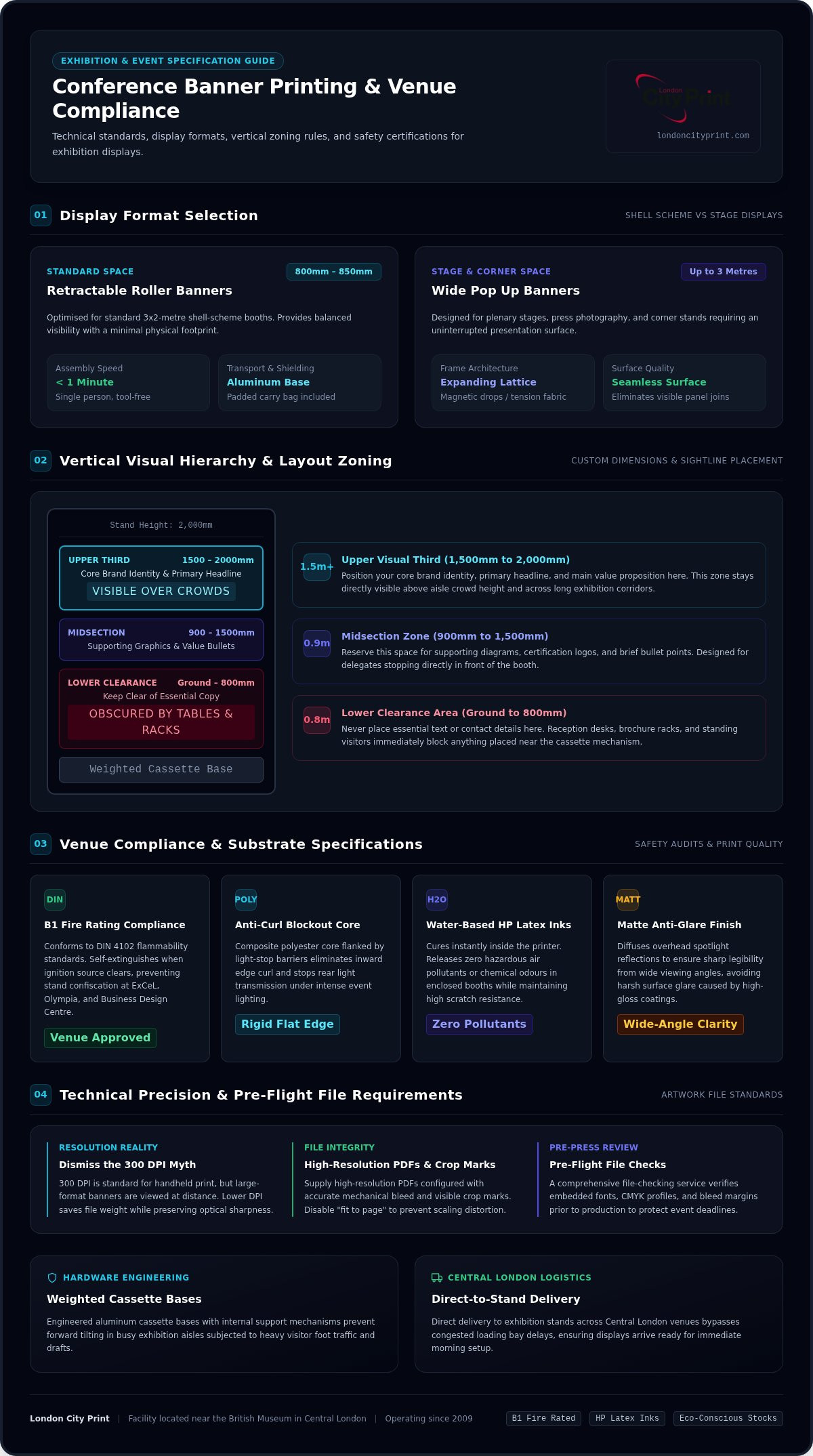
- Upper Visual Third (1,500mm to 2,000mm): Position your core brand identity, primary headline, and value proposition here. This zone remains visible above crowd height across busy aisles.
- Midsection (900mm to 1,500mm): Reserve this space for supporting graphics, certification logos, and brief bullet points.
- Lower Clearance (Ground to 800mm): Keep this area clear of essential copy. Reception counters, brochure racks, and standing visitors immediately block anything placed near the cassette mechanism.
Your standing displays should introduce your key message, not carry exhaustive paragraphs. Direct interested delegates from your banners directly to detailed print collateral on your tables by pairing large-format displays with professional booklets and brochures.
Substrates, Inks, and Venue Compliance Standards
Major exhibition centres enforce stringent safety and presentation criteria. When planning conference banner printing, your material selection directly affects whether your stand passes site safety inspections. Meeting statutory venue compliance and safety standards requires understanding the difference between certified substrates and standard commercial plastics.
Meeting Venue Fire Safety and B1 Certification Rules
Safety officers at venues like ExCeL London, Olympia, and the Business Design Centre inspect temporary structures prior to public entry. They routinely demand proof of flammability testing. Substrates with a certified B1 fire rating conform to DIN 4102 standards, confirming the graphic is flame-retardant and self-extinguishes once an ignition source clears. Standard promotional PVC vinyl lacks this resistance, burns rapidly, and risks on-the-spot confiscation by venue marshals during setup audits.
Ink Technology and Anti-Curl Edge Stability
Substrate construction dictates physical stability under intense trade show spotlights. Budget vinyl graphics suffer from edge curl, bowing inward and obscuring text within hours. To maintain edge rigidity, select composite blockout substrates featuring a polyester core flanked by light-stop barriers. This layered construction eliminates rear light transmission while keeping the display perfectly flat.
Surface reflectivity and chemical emissions are equally vital. Consider these core benefits of modern ink and finish combinations:
- Matte Anti-Glare Finishes: Halogen and LED floodlights cause harsh surface reflections on gloss films. Anti-glare matte finishes ensure your text remains legible from sharp angles across crowded halls.
- Water-Based HP Latex Inks: Traditional solvent inks release volatile organic compounds that emit foul chemical smells in confined booths. Water-based HP Latex inks cure immediately inside the printer, produce zero hazardous air pollutants, and deliver scratch-resistant graphics that won’t scuff during transport.
Eco-Conscious Stocks for Sustainable Trade Shows
Corporate sustainability mandates now influence procurement across the events sector. Polypropylene media and woven polyester fabrics provide recyclable alternatives to traditional PVC sheeting without degrading colour accuracy or tensile strength. You can reinforce these environmental goals by specifying FSC-certified stock across your perimeter displays and matching large format poster printing.
If you need certified compliance documentation for your upcoming event, you can consult the large-format team at London City Print to verify material fire ratings before sending your artwork into production.
Preparing Print-Ready Artwork and File Technical Precision
Flawless output for conference banner printing starts in your design software. File preparation errors cause the majority of pre-press delays and visual defects on exhibition floors. Achieving exact colour matching and crisp typography requires strict technical precision before you export your final graphics.
The 300 DPI Myth and Real-World Viewing Distances
The common belief that large-format graphics require 300 dots per inch is an industry myth. The 300 DPI myth stems from commercial brochure and business stationery production, where readers hold documents 30 centimetres from their eyes. For pull-up displays and stage backdrops viewed from one to three metres away, that level of pixel density is unnecessary.
Exporting a two-metre graphic at 300 DPI generates multi-gigabyte files that crash automated prepress RIP software and stall production queues. Setting your raster imagery to 100 to 150 DPI at 100% physical scale provides razor-sharp output across normal exhibition viewing distances without inflating file sizes. Keep all corporate logos, text, and icons in pure vector formats so they retain infinite scalability regardless of final dimensions.
Bleed, Crop Marks, and Cassette Allowances
Retractable hardware demands specific layout parameters that differ from standard sheet-fed printing. Set up high-resolution PDFs using these mechanical specifications:
- External Bleed and Crop Marks: Include a minimum of 3mm to 5mm external bleed around all edges, accompanied by standard crop marks. This gives the finishing team room to trim without exposing white slivers.
- Lower Cassette Allowance: Add an extra 150mm to 200mm of background artwork to the bottom edge. This non-visible margin remains coiled inside the roller spring mechanism, preventing bare substrate from showing at the floor line.
- Scaling Controls: Disable automatic fit to page print driver options when generating proofs. Forcing artwork to auto-scale distorts your aspect ratios and shifts critical elements out of alignment.
Pre-Flight File Checks and Colour Profiles
Uncalibrated colour models quickly ruin corporate brand consistency. Digital monitors display graphics in RGB light, but wide-format production presses reproduce images using CMYK ink sets. Convert your assets to CMYK before saving to prevent dull or muddy shifts in brand blues and saturated greens.
Dedicated pre-flight file checks eliminate surprises by verifying embedded fonts, image resolutions, and cut lines prior to RIP processing. When you need to match specific Pantone codes across diverse branded assets, such as coordinating your standing banners alongside custom vinyl window graphics, requesting digital samples ensures uniform visual fidelity across every surface.
Evaluating Stand Hardware, Cassette Bases, and Durability
High-resolution graphics lose their impact if paired with inferior mechanics. In conference banner printing, mechanical hardware failure remains a frequent source of booth frustration. Cheap banner stands often lean forward into aisles, suffer broken internal tension springs, or wobble whenever visitors walk past. Selecting solid, weighted hardware guarantees your presentation stays straight and reliable across multi-day trade shows.
Mechanical Stability in High-Traffic Trade Shows
High-traffic exhibition halls require hardware engineered to resist physical knocks. Thin aluminum casings with lightweight plastic components buckle under continuous handling. In contrast, thick, heavy-duty aluminum cassettes feature an internal ballast that lowers the display’s centre of gravity, preventing it from toppling when delegates brush past your perimeter.
Base architecture also impacts corridor safety. Budget stands use thin swing-out stabilizing feet that extend into walking lanes, creating immediate tripping hazards in tight shell-scheme booths. Premium cassettes feature wide, flat profiles that stay flush against the floor without external feet. Combine this with rigid three-piece bungee poles or secure telescopic rear supports to eliminate loose fittings, ensuring your graphic panel stands vertical rather than tilting awkwardly forward.
Field Durability and Repackaging Protection
Frequent transport across convention circuits exposes event hardware to severe mechanical wear. You can safeguard your hardware investment by verifying three key mechanical factors:
- Foam-Lined Carry Cases: Standard nylon slips offer minimal impact resistance during courier transit. Padded, foam-lined cases protect the internal roller mechanisms and keep structural ends from denting.
- Protective Finishing: Hard anodised aluminum bodies resist scuffing during setup, shielding adjoining graphics from abrasive friction when packed together.
- Replaceable Graphic Cartridges: Premium cassettes allow print technicians to exchange graphic banners without discarding the roller assembly. This lets you refresh visual campaigns across multi-city tours while retaining your durable base units.
If you need dependable, reusable hardware for upcoming trade shows, you can order professional roller banners from London City Print configured with weighted aluminum cassettes engineered to withstand heavy event traffic.
Fast-Track Production and Direct-to-Stand Delivery
Executing event marketing requires navigating tight production deadlines and strict venue logistics. National commodity printers operating outside the capital often ship through general freight networks that cannot manage venue access slots. Sourcing conference banner printing from a Central London facility operating near major transport hubs eliminates the risk of goods trapped in depot backlogs while your setup window expires.
Meeting High-Stakes Conference Setup Deadlines
Marketing teams often face unexpected artwork corrections, sponsor additions, or damaged hardware on exhibition eve. Remote print hubs cannot handle same-day turnarounds. Working with a dedicated Central London print partner allows you to submit revised files through an expedited pre-flight review pipeline for immediate output.
Whether you require an urgent same-day turnaround or a dependable overnight printing service, local production keeps your timeline intact. Professional print shops running high-capacity digital machinery can process, assemble, and inspect replacement roller banners within hours, ensuring your branding stands ready before trade show registration opens.
Direct Delivery to ExCeL, Olympia, and Central London Venues
Exhibition halls enforce strict freight procedures during build days. Standard couriers routinely abandon packages at congested perimeter security gates because they lack site passes or assigned dock allocations. Coordinating delivery directly to your stand guarantees your hardware arrives precisely where your setup team is working.
To avoid delivery confusion across massive complexes like ExCeL London, Olympia, or the QEII Centre, provide these precise logistical markers when booking production:
- Venue Details: Specify the exact exhibition hall name (such as ICC Capital Hall, Grand Hall, or Level 1 West).
- Booth Number: Provide your assigned stand code and company exhibiting name clearly on the delivery manifest.
- On-Site Point of Contact: List the mobile number of the stand manager present during your allocated setup slot.
- Marshalling Access Window: Confirm the strict loading bay delivery window mandated by event organizers.
Consolidating all printed collateral into a single direct-to-venue delivery minimizes administrative stress on event day. You can bundle your completed display hardware alongside event literature and essential business card printing, receiving fully assembled, quality-checked marketing assets right at your booth.
Secure Flawless Event Displays for Your Next Exhibition
Executing successful event branding comes down to clear preparation and dependable manufacturing. Professional conference banner printing protects your brand identity on the trade show floor by pairing verified B1 flame-retardant substrates with heavy-duty aluminum hardware that will not sag or tilt. When you balance technical precision in your design files with anti-glare, odour-free finishes, your booth naturally draws visitor attention for all the right reasons.
You don’t need to leave event delivery to chance. Operating near the British Museum since 2009, London City Print produces scratch-resistant displays using water-based HP Latex inks to ensure sharp colour consistency and complete venue compliance. Whether you are facing sudden artwork changes or tight move-in windows at major London exhibition centers, our rapid turnaround options and direct-to-stand couriers keep your schedule on track. Take the uncertainty out of your exhibition preparation today. Order your conference banners from London City Print and step onto the exhibition floor with total confidence.
Frequently Asked Questions
What is the standard size for an indoor conference roller banner?
The standard size for an indoor conference roller banner is 800mm or 850mm wide by 2,000mm high. These dimensions fit neatly within standard shell-scheme exhibition booths without encroaching on walking aisles. Wider formats, including 1,000mm, 1,200mm, and 1,500mm options, are available for larger spaces. Always check your allocated booth dimensions to ensure your banner height clears low-hanging venue lighting or overhead rigging.
Why do London exhibition venues require B1 fire certification for banners?
London exhibition centers like ExCeL and Olympia require B1 fire certification to protect public safety in enclosed gathering spaces. Materials with a certified B1 fire rating are flame-retardant and self-extinguish when exposed to small open flames. Venues conduct strict inspections during build days. If your graphics lack written certification or test documentation, safety officers can prohibit you from displaying them on the show floor.
Can you deliver printed conference banners directly to my exhibition booth?
Yes, direct-to-stand delivery is available for venues across London. Our couriers navigate loading bay marshal systems at ExCeL, Olympia, and Central London conference hotels. When ordering conference banner printing, supply your exhibition hall name, booth number, and the on-site contact number for your stand manager. We deliver fully assembled hardware straight to your stand location within your assigned setup window, keeping your team focused on event preparations.
What file format and resolution should I supply for large-format banner printing?
Supply your artwork as high-resolution PDFs saved in the CMYK colour space. Ensure raster images are set between 100 and 150 DPI at 100% full print scale, which keeps file sizes manageable while delivering crisp clarity. Keep all typography and logos in vector format, outline your fonts, and add 3mm to 5mm of external bleed along with crop marks. Don’t forget to include the bottom cassette allowance.
How fast can a replacement roller banner be printed if our graphics are damaged?
Replacement roller banners can be printed and dispatched on the same day when emergencies strike during setup. Operating from Central London near the British Museum, our production facility offers urgent same-day and overnight printing services for corporate clients facing tight deadlines. If your files pass pre-flight checks quickly, we can manufacture, assemble, and courier your replacement banner directly to your venue before the exhibition doors open.
What is the difference between budget and heavy-duty banner cassette hardware?
Budget cassettes rely on thin aluminum and swing-out plastic feet that can break easily and cause trip hazards in tight aisles. Heavy-duty cassettes feature solid, weighted bases with a lower centre of gravity, eliminating forward lean without external feet. They also incorporate superior internal spring mechanisms and come with padded, protective carry bags, making them dependable investments for repeated commercial use across multiple exhibitions.
Do water-based HP Latex inks smell when unpacked inside enclosed conference halls?
No, water-based HP Latex inks are completely odourless and cure instantly inside the printing system. Traditional solvent inks release noxious volatile organic compounds that linger in unventilated exhibition halls and cause discomfort. With HP Latex technology, your conference banner printing emerges dry, scratch-resistant, and ready for immediate display. They meet stringent environmental standards, making them entirely safe for enclosed convention centers, hospital spaces, and corporate events.