
To understand what paper GSM means, look at the weight of a sheet measuring one metre by one metre. GSM measures paper weight, not thickness or quality. It helps you compare stocks, but doesn’t tell you exactly how thick they’ll feel.
Choosing paper for a flyer, poster or brochure can feel like a small specification with a big effect. You want a stock that suits the design, feels right in the hand and works for its intended use. GSM gives you a practical starting point, but the best choice also depends on the finish and purpose of the printed piece.
This guide explains how GSM differs from thickness, what weights are common for everyday paper, and how to narrow down a suitable range for flyers, posters and brochures. You’ll see why a lighter sheet can be easier to fold, while heavier stock can feel more substantial, and what else to consider before sending a print job into production.
Key Takeaways
- GSM tells you the weight of a square metre of paper, not its exact thickness or quality.
- Standard printer paper commonly falls within the 70-100 gsm range, while heavier stocks suit different print uses.
- For flyers and posters, consider how the piece will be handled and whether it needs to fold easily or feel more substantial.
- Compare paper by both GSM and intended use: stocks with the same GSM can still differ in thickness.
- Choose a paper weight alongside the design, finish and purpose of your brochure or poster for a more suitable result.
What does GSM paper mean in printing?
GSM describes paper weight in grams per square metre. This figure helps you compare stocks for different print jobs, from newspaper pages to invitations.
It’s a useful guide when choosing paper, but doesn’t describe every quality of a sheet. Paper composition and finish also affect how a stock feels and performs in print.
GSM Meaning and Measurement
GSM means grams per square metre, the weight of a paper sample measuring one square metre. To determine it, a square metre of paper is cut to size and weighed. A stock marked 100 GSM therefore weighs 100 grams per square metre. This standard gives printers and buyers a shared way to compare paper weight across sheet sizes and print materials.
For example, A4 paper measures 210 × 297 mm, while A5 measures 148 × 210 mm. The A-series paper sizes described here are part of the ISO 216 standard, according to the International Organization for Standardization. GSM remains tied to the square metre, so the weight rating doesn’t change when the paper is cut into A4 or A5 sheets.
Paper Weight and Thickness
GSM measures paper weight, not its exact thickness. A 350 GSM sheet is heavier per square metre than an 80 GSM sheet, but GSM alone doesn’t specify how thick either sheet feels. That distinction matters when a design needs to fold, stack or fit inside an envelope. Use the GSM figure to compare weight, then consider thickness as a separate print specification.
Two paper stocks carrying the same GSM can still differ in thickness. For instance, one brand’s 350 GSM card isn’t necessarily as thick as another brand’s 350 GSM card. Paper structure and composition affect the finished sheet. If a job depends on a particular feel or fit, assess the stock itself rather than assuming the weight label tells the whole story.
Choosing Paper Weight for Print Materials
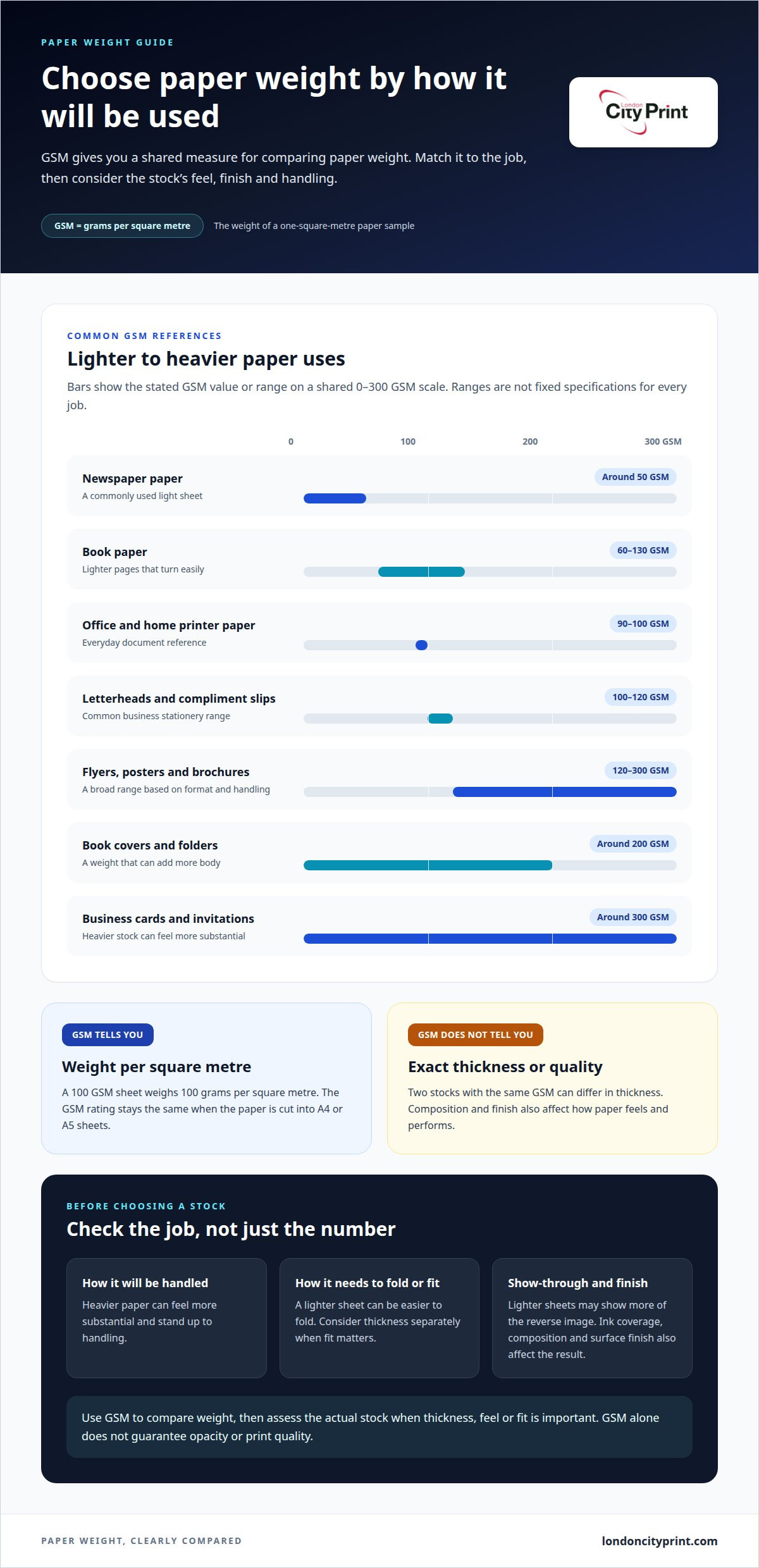
Match paper weight to the material’s purpose and handling. Newspapers commonly use paper around 50 GSM, while book paper ranges from 60 to 130 GSM. These lighter weights suit pages that need to turn easily and form a practical stack. A different choice may suit a cover, folder or invitation that needs more body.
Business cards often use card around 300 GSM, and invitations may use 300 GSM paper. Paper around 200 GSM can suit book covers and folders. These figures are starting points, not a universal specification for every design. A compact card, a folded folder and a multi-page book each place different demands on weight, flexibility and thickness.
Weight Effects on Print Results
Paper weight can influence how substantial a printed item feels and how well it stands up to handling. A heavier business card can feel more substantial than a lightweight sheet. For a folder, the choice also affects how the material bends and holds its shape. Consider the finished format and how recipients will use it.
Weight can also affect opacity, or how much printing shows through from the reverse side. A lighter sheet may reveal more of its reverse image, especially with dense printing. Heavier stock may reduce show-through, but GSM doesn’t guarantee opacity or print quality. Ink coverage, paper composition and surface finish also shape the result, so treat weight as one factor when choosing stock.
How many gsm is normal paper?
For household and office printers, paper commonly weighs 90-100 GSM. That range gives you a practical reference when selecting stock for everyday documents, but “normal” isn’t one universal specification. A paper guide may group weights by intended use, printer compatibility, or local labelling conventions. If you’re asking “what is paper GSM?”, you’re looking for a paper-weight measure that helps make those specifications easier to compare.
GSM means grams per square metre, and grammage is the technical term for that measurement. ISO 536 is the international standard for determining the grammage of paper and board. The standard provides a consistent basis for stating a paper’s weight. It doesn’t mean every paper product has the same feel or use, even when its grammage matches another stock.
Paper specifications may also use pounds, so a conversion reference can help interpret unfamiliar labels. A listed comparison equates 100 GSM paper with 67 lb and 120 GSM paper with 81 lb. Read the complete paper specification rather than comparing numbers alone. The unit matters: GSM and pounds express weight using different systems, and the label should identify which system applies.
Grammage helps manufacturers, printers, and buyers describe stock in a shared way. For example, stationery such as letterheads and compliment slips usually weighs 100-120 GSM. This gives you a use-based reference beyond everyday printer paper. A document intended for formal correspondence may call for a different stock selection than routine office copies, even if both need to run through a printer.
What is paper GSM useful for when comparing two specifications? It shows whether one stock has more mass per square metre than another, but doesn’t fully describe the sheet. Paper composition and finish can influence its surface and handling, so consider the grammage alongside the stock’s intended use and other stated properties.
Use the specification to make a clear comparison: identify the unit, note the GSM value, then match it to the document’s purpose. A 90-100 GSM printer stock offers a relevant starting reference for everyday printing, while 100-120 GSM stationery is commonly used for letterheads and compliment slips. These categories help you narrow the selection without treating “normal paper” as one fixed weight.
GSM ranges for flyers, posters, and brochures
For flyers, posters, and brochures, choose a GSM range based on how each item will be handled. Paper used for these products commonly spans 120-300 GSM, with lighter sheets suited to flexible formats and heavier stocks giving a more substantial feel. These are practical ranges, not one fixed specification for every design.
Flyers often use paper from 120-150 GSM when you need a lightweight sheet that bends and folds easily. A 150 GSM flyer feels thin and remains easy to fold. For a firmer handout, 150-200 GSM is commonly used for flyers and posters. Promotional posters and flyers can also fall within 130-250 GSM, depending on the intended use and desired feel.
Consider the distribution method before selecting a flyer weight. A handout that people carry or fold needs flexibility, while a piece intended to stay flat can use a heavier stock. A 250 GSM flyer is thicker and takes more effort to fold than a 150 GSM flyer. That difference matters for designs with a crease, multiple panels, or a format recipients may tuck away.
Posters and flyers can share weight ranges, but their display and handling needs differ. Paper around 120-170 GSM is commonly used for both. For a more substantial promotional piece, 150-200 GSM offers another option. If the poster needs a firm feel, consider the upper end of the range; for a lightweight item that folds or travels easily, a lower weight may suit better.
Brochures need a balance between page flexibility and a quality feel. Paper weighing 260-300 GSM is described as bendable cardstock suitable for high-end brochures or magazines. A brochure with several pages may use different weights for its cover and inner pages, helping the cover feel distinct while keeping the document practical to handle. Choose by finished format, page count, and folding design.
Use this quick guide to narrow your choice:
- 120-150 GSM: Lightweight flyers, takeaway menus, and movie posters.
- 150-200 GSM: Flyers and posters that need more body than a thin sheet.
- 200-300 GSM: Magazine covers and higher-quality flyers or menus.
- 260-300 GSM: Bendable cardstock for high-end brochures or magazines.
Before approving artwork, match the stock to the finished piece. A folded flyer needs a weight that suits its crease, while a brochure cover may benefit from a firmer feel. If you’re preparing flyers for printing, consider the format, folding, and handling together rather than choosing GSM alone.
GSM versus paper thickness
Thickness becomes a practical design constraint when a printed piece must fold, bind, stack or fit inside another item. A brochure’s page block affects its spine, while a folded leaflet needs enough flexibility to close neatly. Plan for the finished format, not just how a loose sheet feels in your hand.
For a bound document, account for the thickness of its pages, cover and binding. A small difference across many pages can change the finished spine width. That matters when artwork continues across the spine or the book needs to sit flush on a shelf. Include the intended page count and binding style in the print specification.
Folding also depends on the sheet’s physical build. A stiff sheet can resist a tight crease, while a more flexible sheet may fold more readily. If a design has several panels, consider how the layers meet when closed. Test the fold on a sample of the chosen stock before production, especially when the design has fine lines near the crease.
Thickness can affect how a print job moves through production. Specify the finished stock and intended process so the paper suits the printing and finishing stages. For example, a sheet selected for a folded brochure must work for both image placement and creasing. A mismatch can affect registration, fold alignment or how the finished piece sits.
Think about the full stack, too. Inserts, cards and folded leaflets take up space according to the combined sheets and their construction. If the finished items must fit a presentation folder or mailing sleeve, allow for that clearance in the design. This is especially useful when several printed components sit together.
Before approving a job, define what the finished item needs to do:
- For binding: Consider page count, cover construction, and the space needed for the spine.
- For folding: Review panel layout, crease position, and how the piece closes.
- For fitting: Allow room for the completed print to sit inside its folder, sleeve, or holder.
- For finishing: Include the planned creasing, trimming, or binding in the stock decision.
A physical sample shows how the selected material handles in its actual format. Fold it, place it beside the other components and assess the finished shape before approving the production file. This simple test can reveal practical fit or finishing issues that a paper specification alone won’t show.
How does paper GSM affect durability, opacity, and print quality?
GSM can guide your stock selection, but the finished result also depends on what the paper must withstand. A takeaway menu handled repeatedly faces different wear from a one-use announcement. Consider scuffing, edge wear, creasing and how the item will be carried. These practical demands help you specify suitable stock instead of choosing by weight alone.
Durability also depends on the paper’s construction and how you finish the piece. A folded handout may wear along its creases, while a frequently handled card may show marks at the edges. Plan around these stress points, and keep essential text away from areas that will be folded, trimmed or handled often.
Opacity matters when artwork or text appears on both sides. The paper’s composition and formation influence how much light passes through it. For a double-sided document, inspect the reverse side under the lighting where people will read it. This review can reveal distracting show-through behind small type or pale backgrounds before you approve the final artwork.
Print quality depends on how the paper surface interacts with ink or toner. A smoother surface can support crisp small text and fine lines, while a more textured sheet can change their appearance. For a design with detailed diagrams, check line edges and small labels on a proof. For photographs, assess whether shadows and midtones remain clear on the selected stock.
Colour also needs to work with the paper’s surface and shade. A warm-toned sheet can shift neutral colours, while a textured surface may make a solid area look less even. Review a proof with the actual artwork, not a blank stock sample. Pay particular attention to brand colours, fine reverse text and large blocks of ink.
Before production, assess the sample against the job’s real requirements:
- Handling: Fold or carry a sample as recipients will handle the finished piece.
- Opacity: View both sides under the intended reading light.
- Detail: Inspect small type, fine rules, and image shadows on a printed proof.
- Colour: Compare key artwork colours on the chosen paper surface.
These checks distinguish paper weight from the qualities that shape the final impression. Stock that suits the design should handle its intended use, keep content readable and reproduce important details clearly. Assess the actual artwork and finished format, so your decision reflects the whole print job rather than one specification in isolation.
London City Print
London City Print produces Booklets and Brochures, Posters and other materials where paper choice shapes the finished result. If you’re weighing up GSM for a folded brochure, display poster or bound booklet, consider the format, handling and intended impression together. GSM helps compare paper weight, while thickness and finish also affect how the printed piece feels and performs.
For a multi-page booklet, wire binding keeps pages together and lets the document lie flat. Posters need a stock suited to their display and handling requirements. Share your design and intended use with the print team so the paper choice supports the finished piece.
Contact London City Print to discuss your print project and paper requirements.
Put your paper choice to work
Now that you understand what paper GSM means, turn that knowledge into a clear print specification. Start with what the finished piece must do: how it will be handled, displayed, folded or stored. Then decide the feel and appearance you want. This gives your print brief a practical direction without treating GSM as the only measure of suitability.
Include the format, intended use, and any requirements for folding or finish when you prepare your project. These details help align the paper choice with the design and the result you expect. If you’re ready to plan your next print job, share your print brief with London City Print and get advice on the paper requirements.
A well-considered specification makes it easier to move from design to finished print with confidence. Set your priorities, write down the details and take the next step with a clear plan.
Frequently Asked Questions
Does GSM indicate paper thickness?
No. GSM indicates paper weight, while thickness describes the distance between a sheet’s surfaces. For a project that must fit a tight sleeve or stack neatly, use a thickness measurement alongside GSM. Two sheets labelled 300 GSM can differ in thickness, so the weight label alone won’t tell you their exact fit. This distinction matters for packaging, folded pieces, and documents with limited storage space.
What are the different GSM paper weights?
Paper weights cover a broad range, from lightweight sheets to firm board. Newspaper stock commonly falls around 35-55 GSM. Craft paper can range from 200-230 GSM, while handmade cards commonly use 240-290 GSM. Rigid card for items such as invitations can range from 350-450 GSM. These examples help you connect a weight category with a use, rather than treating every stock as interchangeable.
Why is GSM important?
GSM gives you a consistent way to compare paper weight before choosing stock. It can help you decide whether a sheet suits a lightweight insert, a folded design or a firm card. For example, a menu that needs regular handling may call for a different feel from a disposable information sheet. Consider the item’s purpose, format and how recipients will handle it.
GSM paper guide: why do different GSMs exist?
Different GSM options suit different print and handling needs. A thin sheet can keep a multi-page document flexible, while thicker card supports items that need a firmer feel. Paper also varies in composition and finish, so weight alone can’t describe every quality. For a layered craft design, lighter card may be easier to cut; an invitation may need more body to hold its shape.
Got more questions about GSM?
If you’re unsure how paper weight fits your design, describe the finished item, how people will use it, and any folding or display requirements. These details help narrow the options beyond GSM alone. London City Print can discuss paper choices for print projects, including brochures and posters. Contact the team to talk through your requirements and the result you want.
How thick is cardstock GSM?
There isn’t one fixed thickness for cardstock at a given GSM. Cardstock can range from 250 to 400 grams per square metre, but stocks within that range can still differ in thickness. Thickness uses a separate measurement: a micron is one thousandth of a millimetre, and 1,000 microns equal 1 millimetre. For a precise fit, specify thickness separately from GSM.
So, should I go for the lowest GSM to save money?
Choose the lowest weight that meets the print’s purpose, handling needs and design requirements, rather than selecting by weight alone. A lightweight sheet may suit an insert, but may not provide the firmness you want for a card or cover. Consider folding, double-sided artwork and how often the item will be handled. The right specification balances these needs with the intended finish.
What does GSM stand for?
GSM stands for grams per square metre. It expresses the weight of a square metre of paper or board, giving you a common unit for comparing stock. For example, a specification of 120 GSM means that one square metre weighs 120 grams. The figure applies to the material, not the weight of an individual A4 sheet, and it doesn’t state the sheet’s exact thickness.