A larger mailing list doesn’t automatically make a direct mail campaign more effective. High impact direct mail printing starts with a clear choice: target people most likely to respond, or reach every address in a defined area.
It’s easy to focus on design and overlook how format, paper, and audience work together. A postcard, flyer, brochure, or booklet creates a different reading experience, while a well-defined audience helps keep the message relevant.
This guide explains how to choose a mail format and paper stock, prepare artwork for print, and decide between targeted mailing and geographic saturation. You’ll also learn how headlines, layouts, and response details can support your campaign’s purpose. With those decisions in place, you can brief a print professional clearly and move from concept to production with fewer delays.
Key Takeaways
- Match postcards, flyers, brochures, or booklets to the amount of information your audience needs.
- Choose coated or uncoated paper based on the look, feel, and readability you want for the mailpiece.
- Prepare print artwork with clear dimensions, CMYK colour, bleed, and space for mailing details.
- Decide whether focused audience targeting or broad geographic coverage better fits your campaign.
- Use format and finishing choices to make the piece stand out while keeping its main message easy to find.
Mail-ready postcards, flyers, brochures, and booklets
Choose a format that presents your message clearly, from a brief postcard offer to a detailed multi-page booklet. The right choice depends on the information, audience, and response action your campaign calls for.
Postcard, Flyer, Brochure, and Booklet Formats
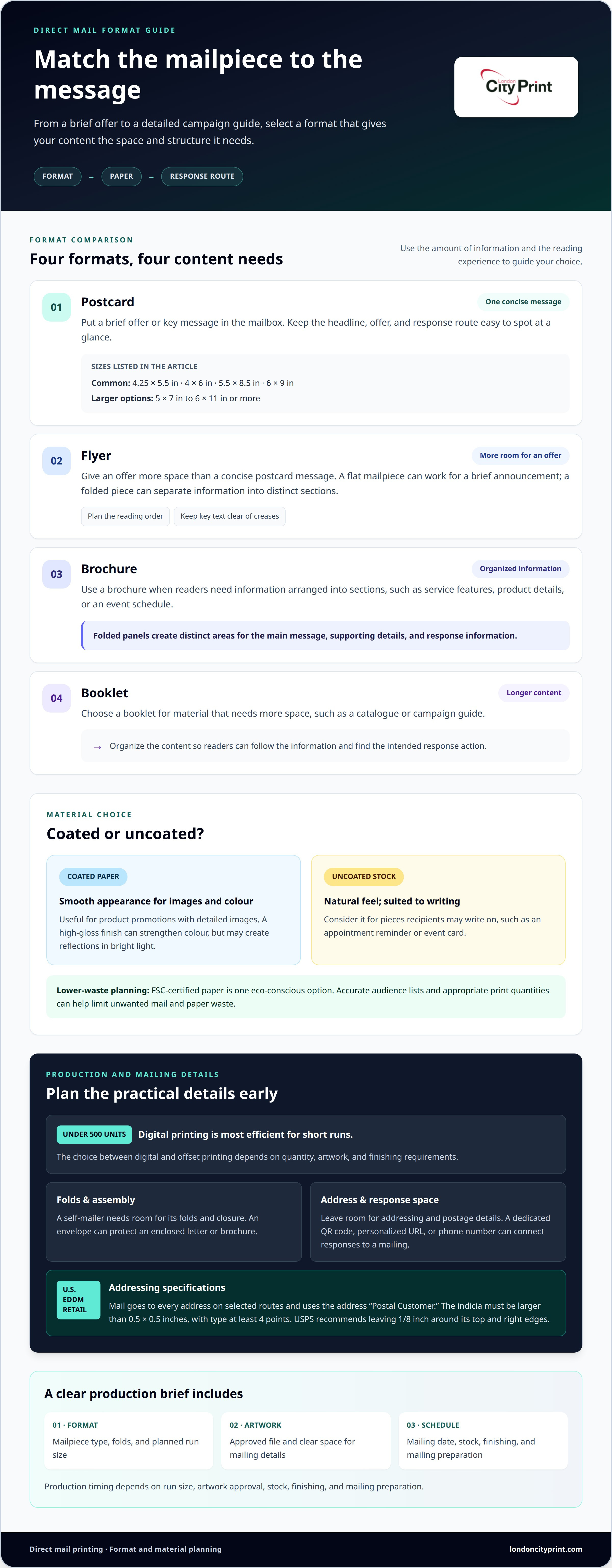
A postcard puts one concise message in the mailbox, while a flyer gives an offer more room. Common postcard sizes include 4.25 x 5.5 inches, 4 x 6 inches, 5.5 x 8.5 inches, and 6 x 9 inches. Larger options range from 5 x 7 inches to 6 x 11 inches or more, leaving space for product details or imagery.
Use a brochure when readers need organized information, such as service features, product details, or an event schedule. A booklet suits longer content, such as a catalogue or campaign guide. Match the format to the amount of information, its visual hierarchy, and the action you want recipients to take.
Postcards can complement digital marketing without replacing it. For example, a postcard can direct recipients to a campaign landing page through a QR code or personalized URL. A testimonial on the front can make the key message immediately visible. Keep the headline, offer, and response route easy to spot at a glance.
Make the offer specific and give recipients a clear reason to respond. A discount, appointment invitation, or product sample can work as an incentive when it suits the campaign. Use a dedicated QR code, personalized URL, or phone number to connect responses to the mailing. For geographic targeting, use your postal service’s mailing guidelines to identify the delivery areas and address requirements that suit your campaign.
Printing Methods, Quantities, and Turnaround
Digital printing is most efficient for short runs under 500 units. Offset printing follows a different production process, so the choice depends on the quantity, artwork, and finishing requirements. Share the planned run size and specifications with the printer so production can be matched to the job.
Production timing depends on run size, artwork approval, stock, finishing, and mailing preparation. A print-ready file and confirmed format help keep the workflow moving, but no single turnaround applies to every campaign. Set the production schedule around your mailing date.
Response rates and return on investment depend on the offer, audience, response route, and resulting sales. Track each campaign with its own QR code, personalized URL, or phone number, then compare attributed revenue with campaign spending. For example, separate response links for two audience segments can show which message generates more enquiries, without assuming either will achieve a particular result.
Direct mail formats and business use cases
Choose a mailpiece to suit its purpose, audience, and response action. Format, folds, material, and address placement all affect how a mailing moves through processing.
Mail Formats, Materials, and Durability
Choose a flat mailpiece for a brief announcement or a folded piece for information that needs distinct sections. Paper thickness and coating affect how a piece feels and holds up during handling. Select stock that supports the design without making the mailpiece difficult to fold, address, or process. A product announcement, event invitation, and service reminder each call for a different amount of space and style.
For a direct mail campaign, match the material to the recipient’s experience. A piece sent through the mail should keep key text legible and its edges presentable. Eco-conscious options include FSC-certified paper. Keeping audience lists accurate and print quantities appropriate can also limit unwanted mail and paper waste.
Folds and Mailer Formats
A flat trifold can present a short sequence of information, while a folded mailer gives readers distinct panels to explore. Plan the reading order before placing copy: lead with the main message, use inner panels for supporting details, and reserve the final panel for the response action. Folds affect available space, so keep essential text clear of creases.
Format also affects mailing preparation. Self-mailers need a layout that accommodates their folds and closure, while an envelope can protect an enclosed letter or brochure. Choose based on how much content recipients need and how the piece will be assembled, addressed, and handled.
Visual Impact, Finishes, and Sustainability
Contrast, a clear headline, and one prominent call to action help a mailpiece stand out. A high-gloss finish can strengthen colour but may create reflections, so consider readability in bright light. Sustainable choices include FSC-certified stock and carefully planned quantities. These can reduce avoidable waste, though printing and delivery still use materials and resources.
Addressing and postage details need room in the design. For U.S. Every Door Direct Mail (EDDM) Retail, mailpieces go to every address on selected routes and use the address “Postal Customer.” The indicia must be larger than 0.5 inches by 0.5 inches, with type at least 4 points. USPS recommends leaving 1/8 inch around its top and right edges.
When comparing printers, look for accurate file checks, clear handling of folds and address areas, and communication about production stages. These details help prevent artwork or assembly issues from disrupting mailing. For practical production planning, discuss your print requirements with a print team.
Coated and uncoated paper options
Paper affects how a mailpiece looks, feels, and performs during handling. A coated surface gives photographs and coloured graphics a smoother appearance, making it useful for a product promotion with detailed images. Uncoated stock feels more natural and suits pieces recipients may want to write on, such as an appointment reminder or event card. Choose according to the message and how recipients are likely to use the piece.
Coated paper can help keep small images and colour contrasts visually distinct. It works well for a travel offer, product launch, or menu where photography carries information. Gloss reflects more light, while a matt surface reduces shine. Consider the reading environment too: glare may distract recipients viewing a piece under bright office lighting.
Uncoated paper is suitable for handwriting and has a softer, less reflective surface. Use it for a response card, personal note, or mailing that asks recipients to add details. If the piece includes a form, check how its fields and instructions read on the paper. A clear writing area matters more than decorative texture when recipients need to complete and return information.
Paper weight affects stiffness and handling, but the right choice depends on the format. A postcard needs enough body to travel as a standalone piece, while a folded leaflet must bend cleanly without cracking at the crease. For an envelope mailing, consider the insert and envelope together. Their combined thickness and feel should suit the contents and presentation.
Before printing, match the stock to the design and finishing. Large areas of dark colour may look different on coated and uncoated surfaces, so review a sample when colour consistency matters. For a mailing list with several versions, keep stock consistent unless each version has a clear purpose. This helps recipients recognize the campaign across its different pieces.
Eco-conscious stocks offer another way to make a selection. FSC-certified paper supports a sourcing choice that can align with a company’s environmental commitments. You can also reduce unnecessary pieces by keeping the mailing list current and matching volume to the intended audience. These steps address material use without weakening the campaign’s message.
Choose paper by assessing four practical factors: image use, handwriting needs, folds, and envelope compatibility. A photo-led promotion may suit coated stock; a return form may call for uncoated paper. If the design promotes a premium product, balance surface finish with legibility and postal handling. The stock should support the action, not compete with it.
Mailpiece design and size requirements
Build the layout around one main message and one intended response. For a product launch, place the product name and key benefit where the eye lands first, then guide readers to supporting details. A clear visual order helps recipients understand the offer without searching through competing text, images, and decorative elements.
Use type size and contrast to distinguish the headline, body copy, and response instructions. For example, a seasonal promotion can use a distinct colour block for its offer while keeping terms readable. Choose typefaces that remain clear at the finished print size, and avoid placing fine text over busy photography.
Plan image crops before production. Keep the main subject away from trim edges, and extend background images into the bleed area to avoid a white sliver after trimming. Add crop marks to indicate the final cut. Check that logos, faces, and other essential artwork remain inside the safe area.
Prepare print artwork in CMYK, the colour mode used for process printing, and export a high-resolution PDF with fonts embedded. RGB artwork can look different after conversion, so review colour-critical elements in a proof. Confirm that the file uses the intended finished dimensions instead of relying on “fit to page,” which can alter scale.
Personalized mailpieces need careful data mapping as well as a sound layout. If each version includes a recipient name or tailored message, keep those fields within defined text areas. Test long names and copy, which can wrap or collide with nearby graphics. Review a sample from each version before approving the full run.
Reserve an uncluttered area for addresses and mailing marks. Keep promotional copy, logos, and decorative elements away from the space assigned to those details. The exact position depends on the mail format and postal preparation, so build the selected mailing method into the print-ready layout from the start.
Before approval, preflight the files for dimensions, bleed, colour profile, image quality, and font embedding. Then review a proof at actual size for spelling, alignment, contrast, and personalized fields. This final check can catch issues such as a cropped logo or misplaced response instruction before production begins.
Postcard designs need a bold, concise headline that conveys the main message instantly. Give it a clear visual role and focus the wording on the single idea recipients should notice first. State the offer, benefit, or invitation directly, removing qualifiers that do not clarify the message. The headline should work with the image and supporting copy, not compete with them. Use strong contrast and enough open space to make it easy to find, while keeping it legible at finished size.
Check the headline in a final-size proof, not just on screen. If it feels crowded, shorten the wording or adjust its placement and hierarchy before approval. Keep secondary details subordinate so the central message is clear at a glance. Review the complete design to ensure the headline leads naturally into the next information and the intended response.
Which direct mail formats and finishes create the strongest visual impact?
The strongest choice supports the campaign message rather than adding decoration for its own sake. A postcard makes one offer immediately visible, while a folded mailer can guide readers through several details. Choose the format by considering the first impression, the information that follows, and the action recipients should take.
A postcard works well for one announcement, such as a product launch or event invitation. Give the headline and main image clear priority, then place the response action where readers can find it quickly. A larger postcard allows more room for imagery and supporting copy, but extra space helps only if the layout stays focused.
Use a folded mailer when your message needs a sequence. The cover can introduce a benefit, inside panels can explain features, and the final panel can direct recipients to respond. A brochure or booklet suits campaigns with several products, locations, or service details. Plan the reading order before selecting images so each panel advances the same message.
Finishes can add contrast or texture to selected design elements. Custom finishing options include embossing, spot UV, or foil stamping. Use one effect to draw attention to a logo, headline, or image detail. Too many competing treatments can make the layout harder to scan, especially when it also includes an offer, address, and response information.
A high-gloss finish can increase colour saturation, but strong reflections may affect readability. A restrained application can suit a photography-led promotion, while an uncoated surface may better support a handwritten note. Match the finish to the content: a premium product image has different needs from a response card recipients must write on.
- For a single offer: Keep a postcard’s headline, image, and response action distinct.
- For a story: Use folded panels to create a clear beginning, middle, and next step.
- For detailed content: Choose a brochure or booklet with an easy-to-follow information order.
- For emphasis: Apply a finish to one important element, not every panel.
Check the final proof at its finished size. Confirm that the headline remains readable, images support the offer, and any finish avoids essential small text. If recipients must act by scanning a QR code, leave clear space around it. For print support with visual materials, discuss your campaign printing and its format requirements.
Companies with strong omnichannel strategies retain 89% of their customers. Variable data printing technology can create highly personalized postcards at scale, supporting tailored campaigns.
London City Print
London City Print can help prepare printed campaign materials that support a consistent visual message. For detailed product information, Booklets and Brochures provide space to organize content. Posters and Roller Banners can carry the campaign design into other settings, while Wire Binding keeps multi-page materials together for easy reference.
Bring your chosen format, artwork, and campaign requirements to London City Print. The team can align the printed piece with your intended dimensions, layout, and finish, helping you move forward with a clear production brief.
Contact London City Print to discuss your print requirements.
Turn Your Campaign Plan Into Print
Make your next step a focused production brief. Set out the audience, campaign objective, selected format, artwork status, and intended response action. This gives London City Print a clear basis for producing high impact direct mail printing suited to each piece’s role in your wider campaign.
You can also plan how printed materials will carry the same message beyond the mailbox. London City Print offers Booklets and Brochures, Posters, and Wire Binding for related campaign materials. A consistent design across print formats helps recipients recognize your message in different settings.
With your requirements in hand, you can move from campaign decisions to a practical production conversation. Discuss your print project with London City Print and take the next step with a clear brief.
Frequently Asked Questions
What is high-impact direct mail printing?
High impact direct mail printing combines a printed mailpiece with a focused audience, clear creative, and a measurable response action. For example, a local theatre might send an event invitation to previous ticket buyers and direct them to a dedicated booking page. The format and design should serve the campaign goal, not rely on decoration alone. A print professional can coordinate artwork, production specifications, and mailing details.
What paper stocks, coatings, and inks are best for high-impact direct mail?
The best combination depends on what recipients need to see or do. A photo-led product promotion may benefit from coated stock, while a reply card to be completed by hand suits an uncoated surface. Coating can change colour appearance and glare, so assess it alongside the artwork. Request a sample when feel or colour matters. Share the intended use and design, then select the stock and finish to suit.
How do professional printers prepare files for direct mail printing, and what should businesses supply?
Printers review artwork against the finished format and production requirements before printing. To get started, supply the approved design, final dimensions, quantity, mailing format, and any versions or personalization fields. Provide campaign mailing data in the agreed format, with recipient fields correctly mapped to each version. A proof gives you a final opportunity to review copy, variable details, and layout before production begins.
How can businesses personalize, target, and measure a direct mail campaign?
Group recipients by relevant traits, such as location, purchase history, or relationship with your business, then tailor the message to each group. For example, a retailer can promote different product categories to distinct customer segments. Track outcomes with a campaign-specific response method, such as a unique landing page or code. Compare responses and completed actions by segment to identify which audience and message best support your objective.
What response rates and ROI can high-impact direct mail campaigns achieve?
Response rates and ROI depend on the offer, audience, response route, and resulting sales. Do not treat 3,573% as a general ROI benchmark; track responses with a dedicated QR code, personalized URL, or phone number.
How do I find and compare high-impact direct mail printers near me?
Compare printers by reviewing their file checks, handling of folds and address areas, and communication about production stages. Share your run size and specifications so production can be matched to the job.