A flyer that earns attention has not yet proved it delivered a return. Measuring ROI of printed flyers means linking responses to outcomes and assessing the revenue attributable to a campaign. Use a distinct coupon code, URL, or QR code to connect responses to the flyer.
A response count alone can’t show whether a campaign succeeded. You also need to know how many responses became customers and how much revenue those customers generated. With a clear tracking method, you can assess results more confidently and make better-informed decisions about future marketing activity.
This guide explains how to set a campaign goal and a clear call to action, then track responses and conversions over a defined period. You’ll also learn how unique coupon codes can help attribute purchases to a flyer and how to review results over time. These steps provide a practical way to understand what your print campaign achieved and where to focus next.
Key Takeaways
- Choose one primary campaign outcome, such as sales or lead generation, so you can judge results against a clear objective.
- Separate responses from completed actions to see where readers move from noticing a flyer to becoming customers.
- Assign each flyer campaign its own coupon or voucher code, then review redemptions alongside other response data.
- Set a response window and review results at regular intervals to spot changes and inform future campaigns.
- Consider repeat purchases and referrals when assessing the longer-term value of customers acquired through print.
1. Why Track ROI in Print Marketing?
A flyer campaign needs more than a distribution count to show what it achieved. Measuring ROI of printed flyers connects responses to outcomes, helping you see whether print activity generated leads, sales, or other desired actions. It also gives you evidence to discuss campaign performance with stakeholders and plan future marketing.
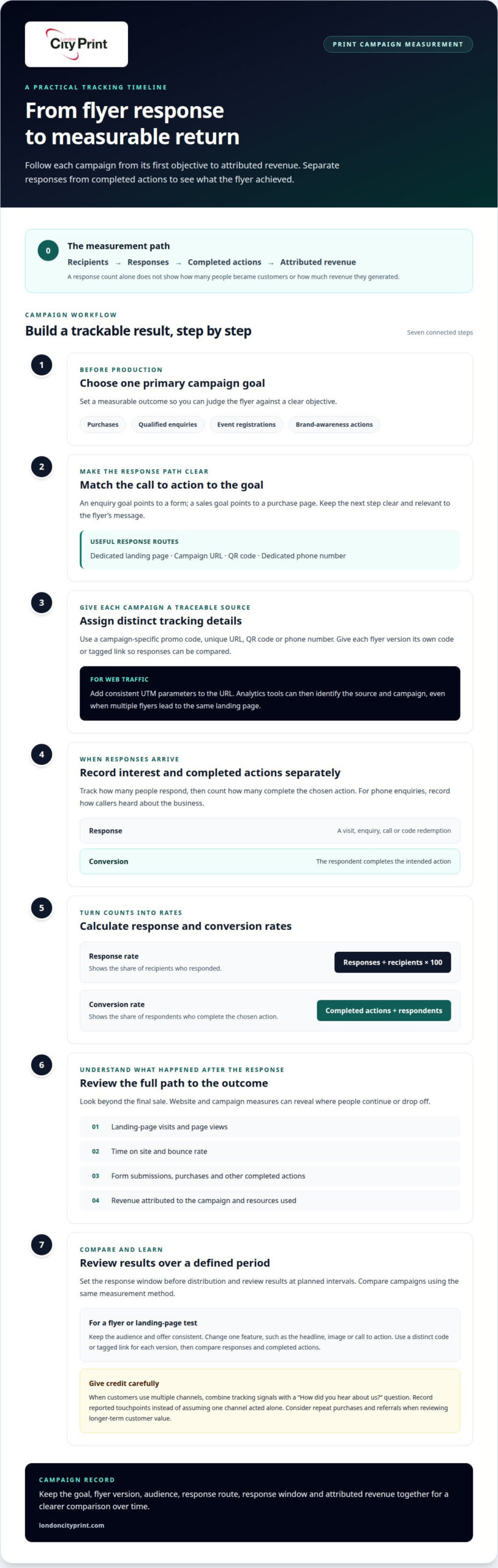
Track responses, response rate, conversions, conversion rate, and revenue attributed to the campaign. Response rate is the number of responses divided by the number of recipients, multiplied by 100. Conversion rate is the share of respondents who complete your chosen action. Add landing page visits, page views, time on site, and bounce rate to understand how visitors behave after responding.
Choose a distinct response route before distributing the flyers. A campaign-specific promo code, dedicated phone number, unique URL, or QR code can connect an action to its print source. For example, assign a different code to each flyer version, then compare redemptions and completed purchases. This helps distinguish initial interest from conversions.
Create a landing page specifically for the print campaign. Match its headline and offer to the flyer so recipients recognise the message when they arrive. Give the page one clear next step, such as submitting an enquiry or completing a purchase. A unique page address makes campaign visits easier to identify in analytics, while a QR code can take recipients straight to the page.
UTM parameters add source details to a URL, allowing analytics tools such as Google Analytics to identify where a visit came from. Use campaign tags consistently in the flyer’s web address, then review traffic and conversions under the relevant source and campaign. A distinct URL with UTM tags can separate one print distribution from another, even when both lead to the same landing page.
Phone responses need the same discipline. Give each campaign a dedicated number, or ask callers how they heard about the business and record their answer. If someone sees the flyer and later encounters a digital marketing message, record both touchpoints where possible. A customer’s answer, a redeemed code, and a tagged visit provide useful evidence without assuming one channel acted alone.
To attribute sales when customers use multiple channels, combine campaign-specific tracking with a simple “How did you hear about us?” question. Record each reported touchpoint alongside the code, phone source, or tagged landing-page visit, then review the customer journey before assigning credit. These steps clarify print results and help you compare campaign responses over time.
QR codes can also take recipients directly to a specific product page, making it possible to assess campaign activity through visits and conversions. For lead-focused campaigns, UTM tags in URLs promoted on the flyer help identify which print tactic generated a landing-page lead. Promo-code or coupon redemptions provide another conversion signal, showing which printed offer prompted action. Together, these measures help assess responses, website visits, leads, and completed conversions.
2. Setting a clear campaign goal and call to action
Set one primary goal before producing a marketing campaign. Choose a measurable outcome, such as purchases, qualified enquiries, event registrations, or brand-awareness actions. A specific target helps you judge whether the flyer’s message and offer generated the intended response. For example, a campaign promoting a product can focus on completed purchases rather than general website traffic.
Make the call to action match the goal. If you want enquiries, ask recipients to complete a form. If you want sales, direct them to a purchase page. Use a special offer only when it supports the campaign objective, and give it a distinct code or response route. Keep the instruction direct, such as “Book an appointment” or “Redeem this offer.”
Each print campaign needs a clear response path. Use a dedicated landing page, campaign URL, QR code, or phone number, and make the next step clear on the page. If the flyer promotes a consultation, the landing page should explain how to request one, not present unrelated choices. This alignment reduces confusion and makes campaign results easier to interpret.
Assess campaign performance by tracking attributed revenue, completed actions, and the resources used to generate them. Keep these measures distinct: revenue records sales attributed to the campaign, while completed actions show how many people responded. This gives you a more useful assessment than counting responses alone.
Use analytics to review the response path, not just the final sale. Check landing-page visits, form submissions, purchases, and drop-offs. If visitors reach the page but don’t complete the action, refine the page or offer. If few recipients visit, review the flyer’s call to action and response route. Change one element at a time so you can interpret the effect.
A/B testing compares two versions of a flyer or landing page to see which performs better. Keep the audience and offer consistent, then change one feature, such as the headline, image, or call to action. Give each version a distinct code or tagged link. Compare responses and completed actions, then apply the stronger version to the next campaign.
Review performance at planned intervals, including after the response period ends. Compare results with the campaign goal and previous campaigns using the same measurement method. Record the version, audience, response route, and attributed revenue together. This creates a useful baseline for future decisions and helps you identify whether a change improved results or simply shifted activity elsewhere.
3. Setting response timeframes to track campaign results
Set a response window before distributing a flyer, then use the same window to assess every version. Its length should reflect how recipients encounter the offer and how quickly they can act. A flyer promoting an immediate booking needs a different window from one introducing a considered purchase. Record the start and end points so late responses don’t blur comparisons.
Separate early activity from completed outcomes. During the response window, track QR code scans, campaign-specific page visits, calls, and code redemptions. Then connect those interactions to completed actions, such as purchases or submitted enquiries. A scan shows engagement, not a sale. Keeping the stages separate gives you a clearer view of campaign effectiveness and conversions.
Use a QR code that points to a dedicated campaign landing page. Review scan dates and page activity in your analytics, then compare them with purchases recorded in your sales system. If a recipient scans near the end of the campaign but buys later, record the sale against the same campaign where tracking allows. This helps prevent delayed decisions from disappearing from your results.
Use one consistent attribution rule for sales and revenue tracking. A redeemed flyer code is a direct signal; a customer’s reported flyer referral is another. Record the purchase date, revenue, and any other reported touchpoints in the same campaign record. If someone responds through both a QR code and a phone call, retain both interactions without counting them as separate customers.
Printed flyer ROI benchmarks aren’t reliable comparisons unless campaigns share the same goal, audience, response window, and conversion definition. Digital advertising, direct mail, and flyers can produce different kinds of interactions, so compare like with like. For example, assess completed purchases across channels rather than comparing flyer scans with digital ad clicks.
Review tracking during the response window and again after it closes. An early check can reveal a broken QR code or landing page before the campaign ends. The final review should include scans, enquiries, completed sales, and attributed revenue. Compare these results with the campaign objective, not just overall website traffic, which may include visitors from unrelated sources.
Keep a record of the timeframe, tracking method, and attribution rule for each campaign. When comparing results later, use the same measurement period and definitions wherever possible. This gives you a consistent basis for assessing return on investment and deciding whether to adjust the offer, response route, or follow-up process for the next flyer campaign.
4. Unique coupon and voucher codes
A unique coupon code gives each print campaign a trackable response marker. Create a different code for each flyer version, audience, or distribution area, then record each redemption against its source. For example, separate codes for two headline variations show which offer prompted more purchases. Keep the code readable, easy to enter, and clearly connected to the flyer’s call to action.
Set the offer terms and recording process before distribution. Tell customers where to enter or present the code, and make sure staff can record in-person redemptions consistently. Your campaign log should capture the code, redemption date, purchase or donation, and print version. This helps distinguish a response from a completed transaction and gives you a reliable way to compare print campaigns.
Coupons can support different goals. A retailer might use a code to attribute purchases, while a service business could track consultation requests linked to a printed offer. The code doesn’t need to identify an individual recipient; it needs to identify the campaign clearly. Avoid reusing codes across unrelated efforts, since shared codes make results harder to separate.
For direct-mail fundraising, assign a distinct donation code to each mailing or audience segment. Record gifts received with that code alongside response dates and donation amounts. This connects donations to a particular print effort and helps assess whether the message generated contributions. If a supporter responds through another route, such as a phone call, record the reported direct-mail influence too.
QR codes can complement coupon codes by taking recipients to a campaign-specific page. Use a different QR destination for each flyer version, then review scans, page visits, and completed actions in analytics. A scan signals engagement, while a submitted donation or purchase records a conversion. Keeping those measures separate prevents scan totals from being mistaken for completed outcomes.
A direct-mail campaign sent a postcard to 100,000 recipients and received 30,000 QR-code scans, a 30% response rate. If 1,000 purchases followed those scans, the conversion rate was 3.3%. These figures describe that example, not a typical result. For your campaign, calculate response and conversion rates from your own recipient, scan, and transaction records.
Review code redemptions alongside revenue and the campaign objective. If one audience uses a code more often but completes fewer purchases, examine the full path from response to transaction. Compare like-for-like offers and distribution groups, and keep code rules consistent. This gives you a clearer picture of which print message prompted action and which audience your next campaign should reach.
5. Why measuring print marketing ROI matters
Print marketing ROI helps you decide whether a campaign deserves continued attention, adjustment, or a different role in your marketing mix. Use the results to compare campaign revenue and outcomes against the resources invested. This evidence can support budget discussions with stakeholders and show how print contributes alongside digital marketing.
ROI also helps you allocate resources. Compare campaigns using consistent goals and attribution rules, then identify which audience, offer, or response route generated stronger results. A lower cost per acquisition makes a campaign more cost-effective, but review lead quality and customer value too. A low acquisition figure has limited value if those customers rarely become paying clients.
Look beyond the first transaction when assessing customer value. A customer acquired through a flyer may make future purchases or refer others. Integrating a digital rewards platform such as BonusQR can help businesses encourage repeat visits and track ongoing engagement. Include those longer-term contributions when your records support the connection, and distinguish projected lifetime value from revenue already received. This gives you a fuller view without treating future business as guaranteed income.
Common mistakes include counting QR scans as sales, omitting campaign expenses, and assigning the same conversion in full to multiple channels. Short response windows can also miss later purchases. Avoid these errors by keeping scans, enquiries, conversions, revenue, and expenses separate, then applying one attribution rule consistently across campaign records.
Print marketing can contribute at different points in a customer journey. A flyer may create initial awareness, while a later digital interaction prompts the final purchase. Review touchpoints together instead of treating the last interaction as the only influence. For example, compare customer reports, campaign codes, and tagged visits before deciding how the flyer supported a conversion.
Use each review to make a specific decision. If a campaign generated enquiries but few paying customers, examine lead quality and follow-up. If customers purchased but revenue didn’t cover campaign expenses, revisit the audience or offer. Record the reason for each change so the next print marketing campaign builds on evidence, not assumptions.
A useful ROI review turns campaign results into a practical next step. Plan your next print campaign with a defined goal, response route, and measurement method.
A concrete comparison can help frame the decision. That gives the business a starting point for comparing case value with advertising spend, but it shouldn’t be treated as complete profit unless other relevant costs and the attribution method are also considered. Keep revenue, expenses, and attribution distinct when interpreting the result.
Another example in the discussion treats $2,000 in new business from a $1,000 advertising campaign as a return of $2 for every $1 spent. This clearly communicates the relationship between spend and business generated, while still leaving room to check whether the amount represents collected revenue, whether the campaign caused the business, and whether other costs affect profitability. Businesses can analyze customer journey touchpoints to understand how print materials contribute from initial awareness through final conversion. Using that broader view alongside consistent records makes the return more useful when deciding whether to continue, refine, or reposition print activity.
London City Print: Flyers
London City Print prints flyers for campaigns that need a clear, trackable response route. Once you’ve defined your audience, offer, and call to action, align the flyer’s message with its campaign-specific code or landing page. This makes each response easier to associate with the printed material.
For campaigns that need more space to explain products or services, Booklets and Brochures can carry supporting information, while Posters can reinforce a message in a physical setting. Choose the format that suits how recipients will encounter the campaign and the action you want them to take.
Contact London City Print to discuss your flyer project.
Put your next flyer campaign into action
Build your next production brief around the audience, message, and action you want to prompt. Use what you learned from measuring ROI of printed flyers to develop a fresh creative direction, rather than simply repeating an earlier design. Keep the response route visible and make the main message easy to understand at a glance.
London City Print can produce flyers for your campaign. If readers need more detail, Booklets and Brochures can expand on the message. Posters can reinforce it in a physical setting, while wire binding can keep related pages together in a presentation. Choose formats that support the same campaign purpose and give your audience a consistent experience.
Before production, bring the campaign brief and response plan together so the design and tracking method work in sync. That gives your team a clear starting point for the next print project. Discuss your flyer requirements with London City Print and move your next campaign forward with a defined plan.
Frequently Asked Questions
Why Track ROI in Print Marketing?
Track ROI to see whether a flyer campaign contributes outcomes your team can act on, rather than merely generating attention. For example, if a campaign supports a store opening, assess its results against that specific business objective before repeating the approach elsewhere. A clear record also helps stakeholders decide whether to continue, revise, or pause the investment based on its contribution to business goals.
How can you use QR codes, promo codes, and landing pages to track flyer conversions?
Connect each flyer response to a campaign record that follows the customer through to completion. For example, a retailer can assign a flyer code at checkout and record the same campaign source in its sales system. A QR code can take recipients to a campaign landing page, where analytics records page activity. Compare those records with completed orders, and keep each flyer version identifiable throughout the process.
What response and conversion rates can businesses expect from flyer campaigns?
There is no single response or conversion rate that applies to every flyer campaign. Audience, offer, distribution, and the requested action all affect results. Build expectations from your own previous campaigns with comparable goals and audiences. For a first campaign, treat the results as a baseline, not a promise of future performance. Keep scans, enquiries, and completed sales distinct when reviewing that baseline.