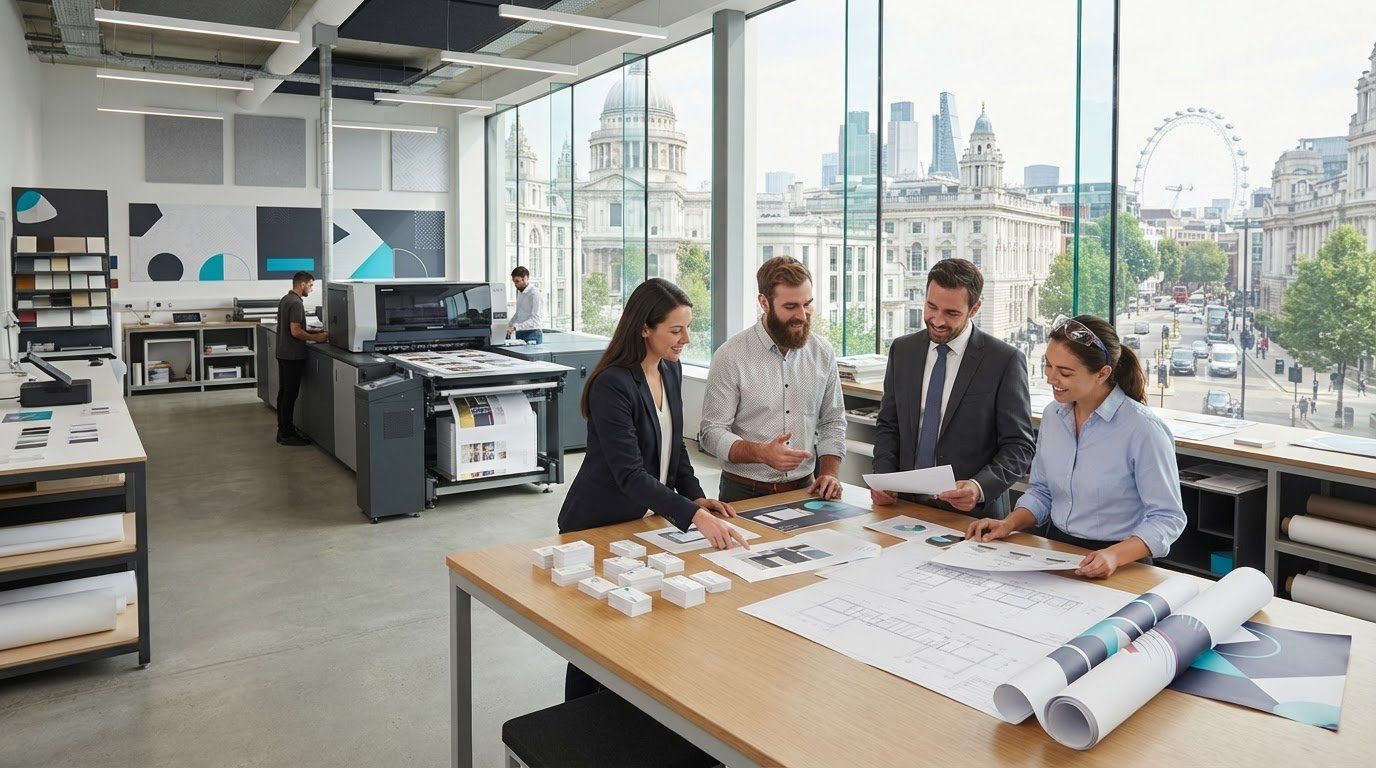
Choosing a copy shop near me is about more than finding the closest place. When a deadline is tight, you need a printer that can handle your specific job and produce it accurately, without avoidable delays.
You may need business cards in one hour, same-day printing for most professional documents, or a specialist job such as a legal bundle, CAD plot or roller banner. London City Print is an independent printing specialist near the British Museum in Central London, supporting business and technical print requirements since 2009.
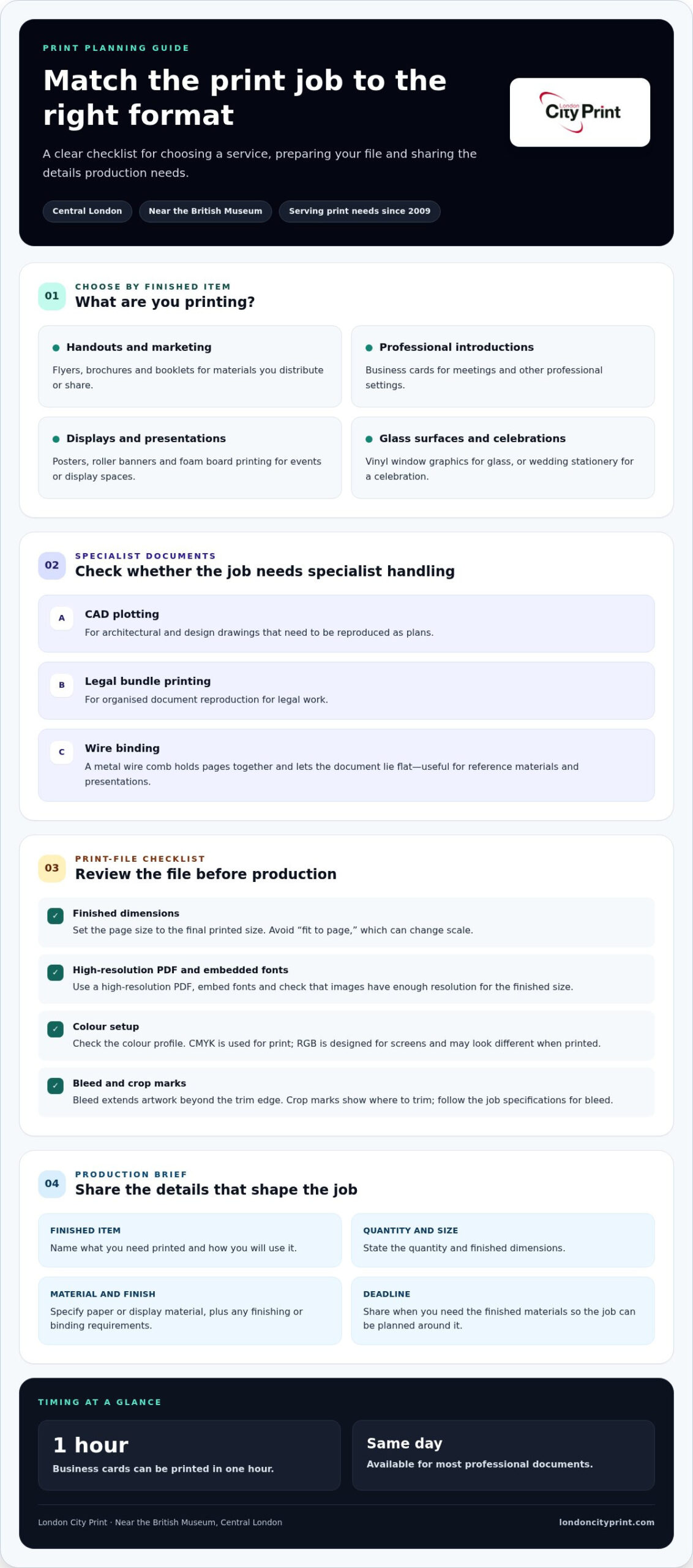
To match your job to the right service, start with the finished item, quantity, dimensions and deadline. Then prepare a high-resolution PDF at the correct finished size, with fonts embedded and any required bleed included. Check the colour setup, especially if your artwork uses CMYK. This guide covers the services available and what to prepare for a smoother production handover.
Key Takeaways
- Choose a copy shop near me by matching the print service to your job, format and deadline.
- London City Print is based near the British Museum and handles marketing, business and technical print requirements.
- Prepare your artwork with the correct dimensions, a high-resolution PDF, CMYK colour and suitable bleed.
- Same-day service is available for most professional documents, while business cards can be printed in one hour.
- Have your final file, quantity, size, colour and finishing requirements ready to help your order move smoothly into production.
Looking for a copy shop near me in Central London? Start with the job
If you need a nearby printer, start with two questions: can it handle your job, and can it meet your deadline? Identify what you need printed, the format and quantity, and when you need it. London City Print is an independent Central London print specialist near the British Museum, serving business and technical print needs since 2009.
A copy shop produces printed materials and related products. That can mean everyday business print, display graphics or documents that need specialist handling. Digital printing is one way to produce printed materials and is often suited to the short-run documents and marketing pieces businesses need.
Which print jobs can a Central London copy shop handle?
Match the service to the finished item. For everyday business print, you can choose business cards, flyers, brochures and booklets. For a display or event, options include posters, roller banners, foam board printing and vinyl window graphics. These formats cover marketing materials for distribution, display or an event space.
Some jobs call for specialist production. London City Print also handles legal bundle printing, CAD plotting and wire binding. Wire binding uses a metal wire comb to hold pages together, allowing a document to lie flat. It can work well for reference materials and presentations that need to stay open. With different formats available through one Central London specialist, you can focus on the job requirements rather than treating every request as a basic photocopy.
When does location matter for a print job?
Proximity can simplify the handover when a deadline is approaching. If you’re preparing for a meeting or event, a Central London print specialist can help you plan around the finished materials without adding an unnecessary cross-city trip. Share your deadline and job details clearly so production can be planned around your needs.
London City Print is near the British Museum, a recognisable Central London landmark. Before you travel, use the company’s contact information for its address and access details. Prepare the essentials for your print brief: the final file, quantity, finished size and any binding or display requirements. A clear brief helps connect your job to the right service and keeps the handover focused.
Match your print job to the right London City Print service
Before choosing a print service, define the finished item and how you’ll use it. A brochure for a client meeting, a poster for an event and a set of technical drawings need different formats. Your production brief should also state the quantity, finished dimensions, paper or display material, and any finishing, such as wire binding. These details help match the print method to the job.
Choose print for business, events, or personal use
For business communication, consider business cards, flyers, brochures or booklets. Wedding stationery can support invitations and other printed pieces for a celebration. For an event, promotion or presentation, posters, roller banners and foam board offer display formats, while vinyl window graphics can carry messages on glass.
Use this quick guide to narrow down the format:
- Handouts and marketing: flyers, brochures and booklets.
- Professional introductions: business cards.
- Displays and presentations: posters, roller banners and foam board printing.
- Glass surfaces: vinyl window graphics.
- Celebrations: wedding stationery.
Find a specialist service for technical documents
CAD plotting suits architectural and design drawings that need to be reproduced as plans. Legal bundle printing focuses on organised document reproduction for legal work. For reports or reference documents that need to lie flat when open, wire binding holds pages together with a metal wire comb.
Refine the brief by confirming the finished size rather than relying on “fit to page,” which can change a document’s scale. Specify the quantity and paper choice, and describe the intended use so the format and finish suit the task. For artwork, check dimensions, colour mode and bleed. The University of Wisconsin-Madison’s print file preparation guide explains details such as bleed and crop marks.
If you’re weighing up formats, review the London City Print services that match your intended use. Then prepare a clear brief with the finished size, quantity and finishing requirements.
Prepare your print files to protect quality and deadlines
A print-ready file helps production move forward without avoidable corrections. Before sending artwork to a copy shop near me, check the document carefully. Confirm the finished dimensions, export a high-resolution PDF, set the colour mode for print, then review bleed and crop marks.
What should a print-ready PDF include?
Set the page size to the final printed dimensions and embed the fonts so the layout stays consistent when the file opens on another system. Use images with enough resolution for the finished size, and check that the document’s colour profile suits print.
CMYK is a colour mode used for print, while RGB is designed for screens. Artwork prepared in RGB may look different when printed, so check your file’s colour settings before sending it. Bleed is artwork that extends beyond the intended trim edge, helping prevent unprinted slivers if the sheet shifts during trimming. Crop marks show where to trim the sheet to the finished size. Follow the print job’s specifications for bleed rather than guessing a measurement.
The British Printing Industries Federation (BPIF) provides information and support for the UK print and graphic communications sector. For practical file setup, the article “Understanding Bleed for Print: A Technical Guide” can help you review this part of your artwork.
How can file checks help with urgent printing?
Pre-flight file checks can identify common technical issues before printing begins.
A missing font, incorrect page dimensions or low-resolution image can lead to corrections that slow down a deadline-sensitive job. London City Print’s file-checking service reviews pre-press details such as bleed, resolution and font embedding. It helps identify potential problems early, so you can address them before production.
Before sending a file, check these points:
- Dimensions: Set the page to the intended finished size.
- PDF: Export a high-resolution PDF and embed fonts.
- Colour: Review the colour profile and use CMYK for print artwork where appropriate.
- Trim: Check bleed and crop marks against the job requirements.
- Images: Make sure image resolution suits the final print size.
Send your final artwork with the required size, quantity and finishing details. Explore London City Print’s print services and prepare your files for a clear production handover.
Plan a Central London print order around your deadline
A deadline-aware print request gives the production team the information needed to plan your job. Before submitting it, gather the final artwork, quantity, finished dimensions, colour requirements and any finishing details, such as wire binding. Include your deadline and allow time to review the proof or final file before production begins.
What information should you provide with a print request?
Be specific about the finished item. State whether you need brochures, posters or legal documents, then provide the quantity and final size. Name your preferred paper or material and describe any finishing requirements. Attach the latest approved print file, not an earlier draft, and make the required completion time clear.
A complete brief helps the team plan production accurately and reduces uncertainty about what you expect. Give the same clear details whether you’re choosing a nearby copy shop or arranging another print job.
- Format: What you need printed.
- Quantity and dimensions: How many copies and the finished size.
- Colour and stock: Your colour requirements and preferred paper or material.
- Finishing: Any binding or other finishing needed.
- Deadline and artwork: Your required completion time and latest approved file.
How do you reduce avoidable production delays?
Review the artwork and approval details before you send the final file. Check the page size, spelling, images and colour, and make sure the file matches the agreed specification. A change after approval can affect the production schedule, so consolidate feedback and submit one final version wherever possible.
London City Print offers same-day service for most professional documents. Business cards in one hour applies specifically to the business-card service, not every print job. Turnaround depends on the service and job details, so include your deadline in the brief to support accurate planning.
With the file approved and the specifications ready, you can move from planning to production with fewer avoidable hold-ups. Discuss your print requirements with London City Print and provide the details needed to plan your order.
Get local print support from London City Print
A successful print order brings together the right service, production-ready artwork and a clear deadline. London City Print provides business, personal, display and technical printing from its Central London facility near the British Museum. Founded in 2009, the company supports print projects across these requirements.
What makes London City Print a practical local option?
Choose a service that fits the finished item, whether you need business cards, flyers, brochures or booklets, wedding stationery, or display materials such as posters, roller banners and foam board. London City Print also handles technical requirements including CAD plotting, legal bundle printing and wire binding. Large-format printing is available up to A0 size and beyond.
Material choices can also form part of your brief. FSC-certified paper and eco-conscious stocks are available for relevant jobs. Include your intended use and preferred stock when you describe the project, so the production details suit the finished print.
A Central London print specialist near the British Museum can make local coordination more practical, particularly when you’re preparing materials for a meeting or event. Plan your handover around the agreed job requirements and the location details provided by London City Print.
How should you take the next step?
Before submitting an enquiry, bring together the information that defines the work:
- Print format: The item or service you need.
- Quantity and size: How many copies and the finished dimensions.
- File status: Whether your artwork is final and ready for production.
- Deadline: When you need the completed order.
- Materials and finishing: Your paper or stock preference and any binding or other finishing requirements.
This clear brief gives the team a practical starting point for planning your print job. For a broader overview, read about Professional Printing Services in London, then share your requirements with the team.
Discuss your print requirements with London City Print and provide your format, quantity, file status and deadline.
Get your next print job ready
The right copy shop near me should match the work you need, the artwork you’re supplying and the deadline you’re working to. Confirm the format, quantity, dimensions and finishing requirements, then send the latest approved file. Clear specifications help the team plan production and reduce avoidable delays.
London City Print has supported print projects since 2009 from its Central London facility near the British Museum. You can access business, display and technical print services, with same-day service available for most professional documents. Business cards in one hour applies specifically to business card printing, not every job.
With the service and file requirements clear, you’re ready to take the next step. Discuss your print requirements with London City Print, including your format, quantity, file status and deadline. Share a clear brief so the team can understand the job and plan the next steps.
Frequently Asked Questions
Where is London City Print located?
London City Print is based in Central London, near the British Museum. If you’re looking for a copy shop near me in this area, the location provides a local option for business, personal and technical print jobs. Use the contact information provided by London City Print for the address and access details before travelling.
Can I get same-day printing in Central London?
Yes, London City Print offers same-day service for most professional documents. This applies to most such jobs, not every print order, so share your deadline alongside the final file and job specifications. Include the document format, quantity, dimensions and finishing requirements. Clear details help the team plan production around your request without assuming every job has the same turnaround.
Can London City Print print business cards in one hour?
Yes, London City Print offers business cards in one hour. This turnaround applies specifically to business card printing, not other products or print jobs. Prepare your approved card artwork and include the quantity and relevant print requirements with your request. Supplying the final version helps avoid confusion between drafts and gives the team the information needed to process the order.
What file format should I send for professional printing?
A high-resolution PDF is suitable for professional print artwork because it can preserve page layout, fonts and image quality. Set the page to the intended finished dimensions, embed fonts, and check image resolution and colour profile. CMYK is commonly used for print, unlike screen-based RGB. Include bleed and crop marks where the job requires them, following the specifications for your print order.
Can London City Print print large-format materials?
Yes, London City Print provides large-format printing up to A0 size and beyond. Its display print options include posters, roller banners, foam board printing and vinyl window graphics. These formats support promotional displays, presentations and event materials. For a clear production brief, prepare the intended finished dimensions and make sure your artwork suits the display format and how you plan to use it.
Does London City Print handle technical documents and binding?
Yes, London City Print handles technical documents through services such as CAD plotting and legal bundle printing. It also offers wire binding, which uses a metal wire comb to hold pages together and lets the document lie flat when open. These services suit different needs, from reproducing design drawings to preparing bound documents. Include the document type and any binding requirements in your print brief.
What should I prepare before requesting a print job?
Prepare the final approved file, print format, quantity, finished dimensions, colour requirements, paper or material preference, and any finishing details. State your deadline clearly. For artwork, check page size, image resolution, colour profile, fonts and bleed before submission. A complete brief gives the production team practical information to plan the job and helps reduce avoidable questions or changes after approval.